

Five Bizarre Fish That Defy Biology and Redefine Ocean Diversity
While the average person might perceive a fish as a basic creature with scales and fins, the ocean's depths reveal a vastly different narrative. Some species have evolved in ways that seem to ignore the standard rules of biology, showcasing adaptations that border on the surreal. From the dark trenches of the Atlantic to the tropical reefs of the Caribbean, these five fish prove that the underwater world is far more diverse and stranger than most of us realize, challenging our fundamental assumptions about marine life.
The Blobfish: A Pressure-Dependent Enigma
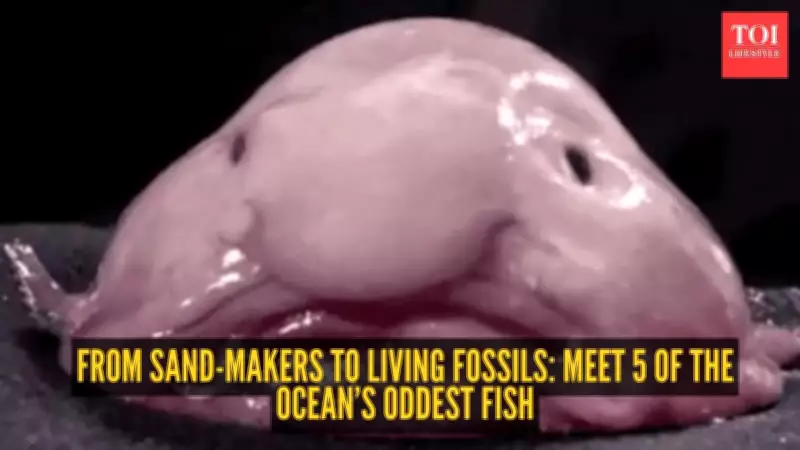
The blobfish is perhaps the most misunderstood resident of the sea, often ridiculed for its appearance without context. Usually found at depths of nearly 4,000 feet, its body is specifically designed to survive in an environment where the pressure is crushing and unforgiving. Because it lacks a solid skeleton or significant muscle mass, it relies on its gelatinous, jelly-like flesh to maintain buoyancy without expending precious energy in the deep sea's harsh conditions.
The famous "melted" or saggy look only occurs when the fish is forcibly brought to the surface. Without the immense weight of the deep ocean to hold its shape intact, the tissues expand and sag dramatically due to pressure changes. In its natural deep-sea home, it resembles a typical fish with a more compact form; on land, it becomes a poignant reminder of how much the environment dictates physical form and adaptation in marine species.

The Blue Parrotfish: Nature's Beach Builder
The blue parrotfish is hard to miss, thanks to its uniform, vibrant blue colour that dazzles in tropical waters. However, its most impressive feature is not its appearance but its monumental contribution to the environment. These fish possess mouths shaped like a bird's beak, which they use to meticulously scrape algae off coral reefs, playing a crucial role in reef health.
As they feed, they also inadvertently swallow bits of the limestone reef structure. Their specialized digestive systems process this rocky material and eventually excrete it as fine, white sand. A single parrotfish can produce hundreds of kilograms of sand over its lifetime, making them essential architects of coastal landscapes. It is a strange and fascinating thought to consider that many of the world's most beautiful and iconic beaches are essentially the result of this fish's ongoing digestive process, highlighting nature's interconnected cycles.
The Candiru: The Amazon's Tiny Terror
Not all fearsome fish are large or visibly intimidating. The candiru, a small catfish found exclusively in the Amazon River basin, is tiny and almost transparent, yet it ranks among the most talked-about parasites in freshwater ecosystems. It typically seeks out the gills of larger fish, where it hitches a ride and feeds on blood and tissue, demonstrating a highly specialized parasitic lifestyle.
While numerous legends and myths circulate about this fish accidentally interacting with humans in distressing ways, the scientific reality is that it is simply a highly evolved scavenger adapted to its niche. Its remarkable ability to locate and latch onto a host in the murky, sediment-filled waters of the Amazon is a testament to how specialized and intricate life in this biodiverse region has become over millennia of evolution.
The Giant Oarfish: Sea Serpent of Reality
For centuries, the Giant Oarfish served as the primary source of sea serpent myths and sailor tales, inspiring folklore across cultures. Growing up to an astonishing 30 feet in length, this ribbon-shaped fish holds the title of the longest bony fish currently known to science. They are rarely observed by people because they inhabit the ocean's "twilight zone," where sunlight barely penetrates and conditions are mysterious.
Unlike most fish that swim horizontally, the oarfish often hangs vertically in the water column, drifting passively with the currents to conserve energy. With its shimmering silver skin and long, flowing red dorsal fin that resembles a mythical mane, it is easy to understand why ancient mariners believed they were witnessing a legendary monster rather than a biological reality, blurring the lines between myth and marine biology.

The Goblin Shark: A Prehistoric Predator
The Goblin Shark is a living link to the prehistoric past, often described as a "living fossil" due to its ancient lineage. It sports a distinctive pink hue and a long, flat snout equipped with specialized sensors that help it detect the faint electrical signals of prey in the perpetual darkness of the deep sea. Its most unusual and terrifying trait is its highly protrusible jaw, which is not fixed to its skull like in most predatory fish.
When it strikes, its jaws can snap forward at high speed with a slingshot-like mechanism to ensnare fish or squid unexpectedly. This adaptation allows the shark to capture fast-moving prey despite being a relatively slow and sluggish swimmer itself. It represents a bizarre but supremely effective evolutionary strategy to survive in an environment where food sources are scarce and competition is fierce, showcasing nature's ingenuity in the deep ocean.
These five extraordinary fish species underscore the incredible diversity and adaptability of marine life, reminding us that the ocean holds secrets far beyond our everyday perceptions. Each one challenges conventional biological norms and invites us to appreciate the wonders lurking beneath the waves.





