

Florida's Unique Ecosystem: Where American Alligators and Crocodiles Coexist
People often confuse American crocodiles (Crocodylus acutus) and American alligators (Alligator mississippiensis) due to their similar appearances, with only subtle physical differences distinguishing them. Despite this resemblance, it is rare to observe these two species together in the wild. However, South Florida stands out as the sole region globally where both apex predators share the same ecosystem, creating a fascinating natural phenomenon.
The Everglades: A Global Intersection for Crocodiles and Alligators
Florida is uniquely positioned as the only place on Earth where American alligators and American crocodiles inhabit the same geographical area. The American alligator's range spans much of the southeastern United States, while the American crocodile's northernmost limit reaches southern Florida. According to the National Park Service, the Everglades feature a distinctive 'brackish' ecosystem—a blend of freshwater and saltwater—that fosters a habitable environment for species in this transitional zone.
American alligators typically occupy inland freshwater marshes, whereas American crocodiles prefer coastal mangroves and salty bays. The presence of American crocodiles in southern Florida is particularly significant, as they are reclusive animals reliant on subtropical conditions for survival. Although they share the same general region, they generally favor different habitat types, maintaining enough distance to minimize frequent conflicts.

The Secret to Their Peaceful Coexistence
Both American crocodiles and alligators inhabit South Florida, but their adaptability to varying water salinity enables them to avoid competition. The National Park Service notes that they 'self-sort' based on their respective adaptations, reducing rivalry for resources.
American crocodiles thrive in the brackish waters of coastal mangroves thanks to specialized salt glands that excrete excess salt from their bodies. In contrast, alligators lack these glands, restricting them to freshwater marshes for nesting and feeding. These adaptations allow each species to exploit different habitat resources, facilitating a peaceful coexistence within their shared ecosystems.
How to Spot the Difference Between an Alligator and a Crocodile
Distinguishing between these predators involves noting key physical traits:
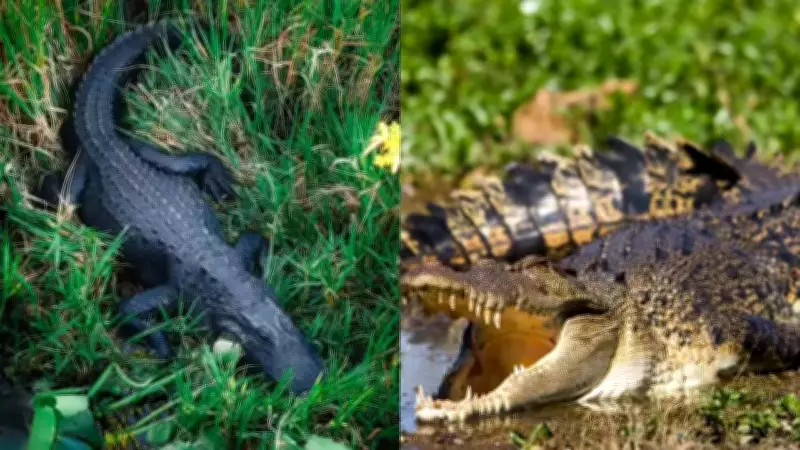
- Snout Shape: Alligators have a wide, U-shaped snout ideal for crushing prey, while crocodiles possess a narrow, V-shaped snout suited for catching prey.
- Teeth Visibility: When their mouths are closed, only the alligator's top row of teeth is visible, whereas the crocodile's fourth lower tooth remains exposed.
- Coloration: Alligators are dark grey or black, blending with murky swamp environments, while crocodiles are lighter, olive-green, matching sunlit mangrove trees for better camouflage.
These differences highlight how each predator excels in Florida's unique environments, from inland swamps to coastal areas.
The delicate ecological balance in the Everglades, supported by the availability of both freshwater and brackish water, allows these apex predators to coexist harmoniously. This rare coexistence underscores the importance of preserving such diverse ecosystems for wildlife conservation.






