Ghaziabad Emerges as India's Most Polluted City in Winter 2025-26
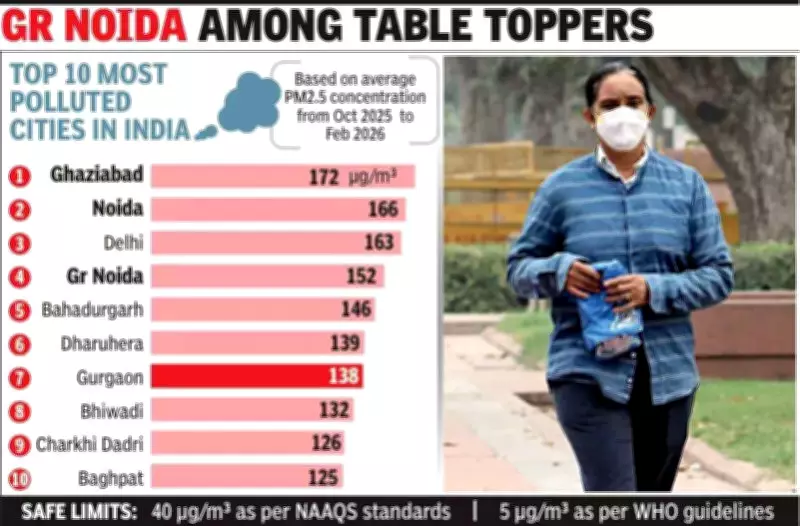
A recent analysis by the Centre for Research on Energy and Clean Air (CREA) has identified Ghaziabad as India's most polluted city during the winter of 2025-26, with Noida and Delhi following closely behind. This study underscores a persistent and severe air quality crisis across the National Capital Region (NCR) and beyond.
Alarming PM2.5 Levels Exceed National Standards
During the winter period from October 1, 2025, to February 28, 2026, Ghaziabad recorded an average PM2.5 concentration of 172 micrograms per cubic metre. This figure is nearly three times higher than India's National Ambient Air Quality Standard (NAAQS) of 60 micrograms per cubic metre for daily ambient air quality. Noida reported an average PM2.5 level of 166 micrograms per cubic metre, while Delhi ranked third with 163 micrograms per cubic metre.
In Delhi, based on average PM2.5 levels, the capital experienced 18 'severe' air quality days, 87 'very poor' days, 24 'poor' days, 15 'moderate' days, six 'satisfactory' days, and just one day in the 'good' category. This data highlights the prolonged exposure of residents to unhealthy air throughout the season.

Gurgaon and Other NCR Cities Face Severe Pollution
Gurgaon ranked seventh among India's ten most-polluted cities, with a winter average PM2.5 concentration of 138 µg/m³, well above the NAAQS of 40 µg/m³. Of the 151 days assessed, PM2.5 levels in Gurgaon surpassed the national standard on 144 days, indicating that air pollution remained above permissible limits for most of the winter. The city recorded 31 'very poor' days and three 'severe' days, along with 11 'moderate' days, four 'satisfactory' days, and only three 'good' air quality days.
The analysis revealed that four cities each from Uttar Pradesh and Haryana ranked among the top ten most polluted, with one city from Rajasthan also on the list. This concentration underscores the widespread severe winter pollution across the NCR and neighboring states.
State-Wise Data Shows Elevated Pollution in Haryana
State-wise figures from Haryana displayed multiple cities with elevated winter averages. Key findings include:
- Bahadurgarh: 146 µg/m³
- Dharuhera: 139 µg/m³
- Sonipat: 122 µg/m³
- Manesar: 121 µg/m³
- Rohtak: 109 µg/m³
- Ballabgarh: 104 µg/m³
Other cities such as Faridabad (91 µg/m³), Karnal (87 µg/m³), Kurukshetra (84 µg/m³), Panchkula (79 µg/m³), Fatehabad (76 µg/m³), and Ambala (71 µg/m³) also remained well above the national limit, indicating a regional air quality challenge.
Nationwide Non-Compliance with Air Quality Standards
Nationwide, the analysis covered 238 cities, with 204 recording winter average PM2.5 levels above the national standard. This marks an increase from 173 cities in the previous winter. No city in India met the World Health Organization (WHO) guideline of 5 µg/m³ for PM2.5.
Across the country, winter averages placed 19 cities in the 'good' category, 129 in 'satisfactory', and 65 in 'moderate'. However, 13 cities recorded 'poor' air quality, and 12 fell into the 'very poor' category, reflecting a significant public health concern.
Expert Calls for Stronger Pollution Controls
Manoj Kumar, India analyst at CREA, commented on the findings, stating, "The comparison between the last two winters shows that widespread non-compliance continues, with more cities breaching the national standard in winter 2025–26 than in the previous winter." He emphasized that while the Commission for Air Quality Management (CAQM) has set PM2.5 reduction targets for NCR, similar nationwide targets are urgently needed. Kumar also advocated for stronger controls on pollutants such as sulphur dioxide (SO₂), nitrogen dioxide (NO₂), and volatile organic compounds (VOCs), which contribute to secondary particulate pollution and exacerbate air quality issues.
This analysis, based on data from Continuous Ambient Air Quality Monitoring Stations (CAAQMS), serves as a critical reminder of the ongoing air pollution crisis in India, particularly during winter months, and underscores the need for comprehensive regulatory measures to protect public health and the environment.