

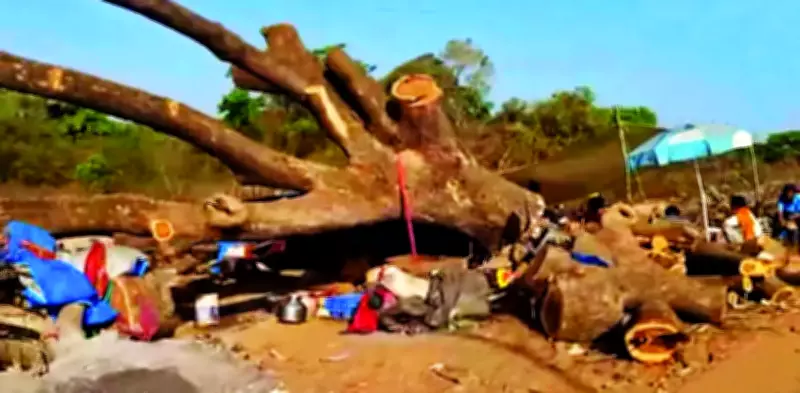
Goa Road Widening Project Triggers Environmental Outcry Over Mass Tree Felling
Environment lovers in Goa have expressed profound and vehement displeasure regarding the extensive felling of a substantial number of mature trees to facilitate the ongoing road widening project connecting Curchorem to Cacora. This contentious development has reignited deep-seated concerns about ecological preservation and governmental accountability in the region.
Historical Precedent and Broken Promises
Activists and local residents have pointedly highlighted a troubling historical precedent. For the earlier phase of this road-widening initiative, which progressed from Tilamol to Curchorem, a large number of trees were indiscriminately felled back in 2016. At that time, when concerned citizens raised the alarm, authorities provided firm assurances. They promised that saplings, in a ratio of three for every single tree removed, would be systematically replanted along the entire corridor to mitigate the environmental damage.
"A decade has passed, and the road-widening work is only now proceeding, and even that is happening in fragmented stretches. We remain completely in the dark about whether any of those promised saplings were ever planted as per the stipulated conditions," a frustrated local resident revealed, underscoring a severe trust deficit.

Community Testimony and Official Justifications
Sanjay Dessai, a regular commuter who relies on this route, provided critical firsthand testimony. He recalled that in 2016, authorities executed the felling of all trees from Tilamol to Kakumoddi in one sweeping operation. The official justification presented at the time was that the land for the project had been acquired approximately two decades prior, seemingly legitimizing the drastic action.
In response to the renewed felling, environmentalists are urgently appealing to the government to impose an immediate halt on any further tree cutting. They argue that the ecological cost far outweighs the infrastructural benefit.
Conflicting Perspectives from Government Departments
Sources within the Public Works Department (PWD) have stated that the land acquisition process for this expansion was completed years ago, implying the project's inevitability. Meanwhile, sources from the state forest department offered a contrasting, and some say dismissive, perspective. They maintained that most of the trees being removed are classified as avenue trees, which they claim hold less forestry value compared to forest trees.
However, this stance has been challenged. "These avenue trees are not merely decorative; they serve as vital carbon sinks and are ecologically invaluable for local biodiversity, air quality, and microclimate regulation," a senior forest department official countered, highlighting an internal disagreement on the ecological assessment.
The situation presents a classic conflict between development and conservation. The community's core demand is not just a stoppage of felling but also transparent accountability for past replanting commitments and a sustainable, ecologically sensitive plan for future infrastructure projects in Goa.






