

Goa's Coastal and River Waters Found Highly Polluted, Unfit for Bathing and Fishing
For Goa, a state heavily reliant on fishing for its diet and tourism for its economy, alarming news has emerged: coastal waters around all major beaches have been found to be polluted. According to recent data, these waters do not meet the Central Pollution Control Board's (CPCB) criteria for SW-II categorization, rendering them unsuitable for bathing, contact water sports, and commercial fishing.
High Faecal Content in Coastal Waters
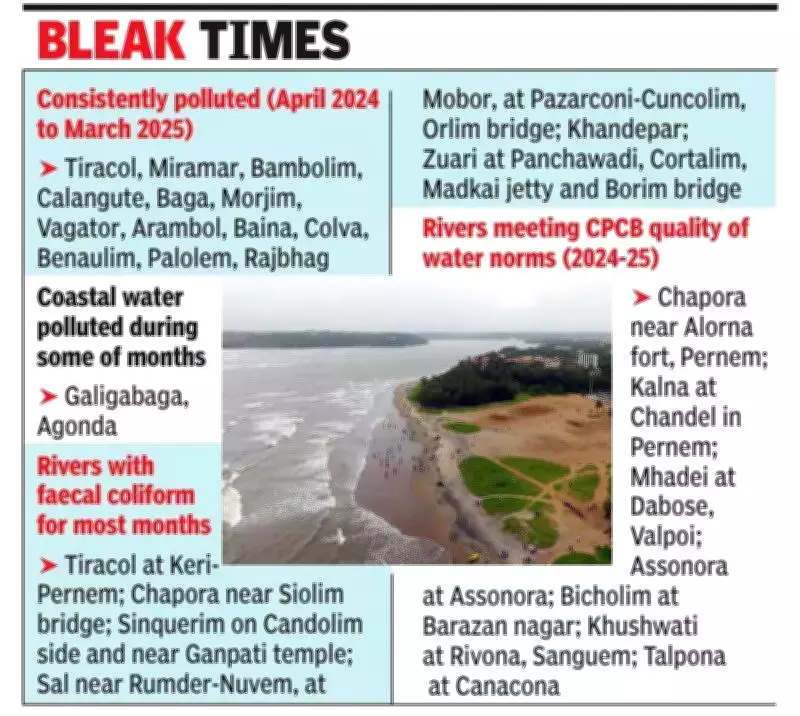
The water consistently tested high for faecal content, exceeding CPCB-prescribed limits, as revealed in a reply tabled during the ongoing assembly session. This contamination was observed at numerous popular beaches, including Tiracol, Miramar, Bambolim, Calangute, Baga, Morjim, Vagator, Arambol, Baina, Colva, Benaulim, and Palolem. Even remote locations like Rajbhag in Canacona were found to be polluted, based on tests conducted by the Goa State Pollution Control Board as part of a national water quality monitoring program.
Notably, three out of four notified olive ridley turtle nesting sites in Goa—Morjim, Galgibaga, and Agonda—also showed high faecal levels, posing a threat to marine wildlife.

River Pollution Extends Beyond Major Waterways
The situation is equally dire for Goa's rivers, with pollution not limited to the well-known Mandovi and Sal rivers. Tests conducted at various points, such as Tiracol at Keri-Pernem, Chapora near the Siolim bridge, and Sinquerim on the Candolim side near the Ganpati temple, all revealed high faecal coliform content. Similarly, water from the Zuari river tested at Panchawadi, Cortalim, Madkai jetty, and Borim bridge exceeded permissible limits.
In some instances, faecal coliform levels were up to 300% higher than the prescribed norm during certain months. For example, in October 2024, the limit was crossed in Khandepar at Opa, where water is tapped for drinking supply treatment. Valvanti in Sanquelim also saw exceeded limits, but only during September 2024.
Understanding the Contamination Metrics
The permissible limit for faecal coliform is 100 or less MPN (most probable number) per 100ml. MPN is a statistical method used in water quality testing to estimate the concentration of viable microorganisms, such as E. coli, by observing fermentation in diluted samples. Shockingly, in July 2024, faecal content in Tiracol was recorded at 3,300 MPN per 100ml, far above the 100 MPN limit.
Government Response and Actions
In response to these findings, Chief Minister Pramod Sawant, who also holds the environment portfolio, stated in the assembly reply that the water resources department has been directed to plug sewage discharge into rivers to improve water quality. This move aims to address the root cause of contamination and safeguard public health and the environment.
The widespread pollution highlights urgent needs for infrastructure upgrades and stricter enforcement of environmental regulations to protect Goa's vital tourism and fishing industries.






