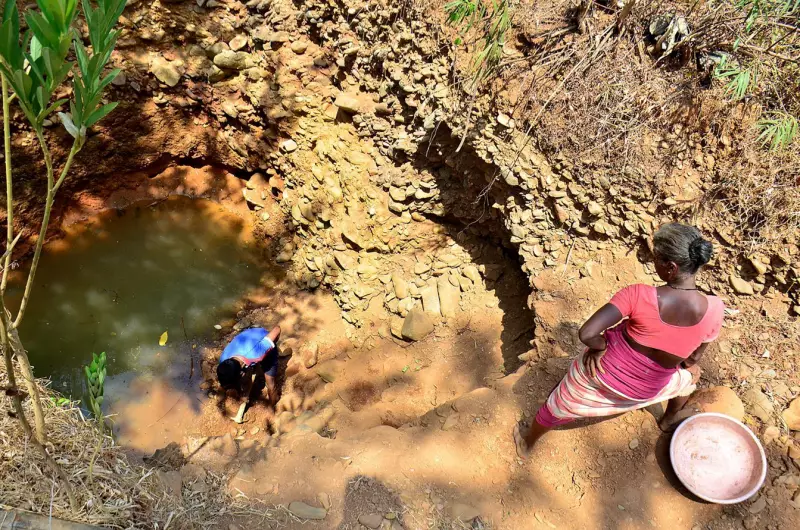
For nearly three months every summer, residents in parts of Goa's Canacona taluka, especially in the hilly villages of Gaondongrim and Cotigao, brace for an acute water crisis. Their dependence shifts overwhelmingly to water stored in barrels as local sources dwindle or dry up.
Groundwater Study Reveals Alarming Deficit
In a significant first, the Central Ground Water Board (CGWB), south-western region based in Bengaluru, has conducted a detailed assessment of the poor groundwater availability plaguing these areas. The study, prepared under the National Aquifer Mapping (NAQUIM 2.0) program, paints a stark picture of the supply-demand gap.
The report calculates that the total water requirement for the two gram panchayats is 448 cubic metres per day. However, the current supply stands at only 318 cubic metres per day, creating a significant daily deficit. The scarcity intensifies during peak summer when the yield from 11 groundwater sources drastically reduces or they dry up completely.

Why the Region Faces This Chronic Scarcity
The CGWB report attributes the persistent problem primarily to the challenging terrain of the region. It notes that vast elevation differences and drastic gradient changes lead to increased surface runoff, leaving minimal water to infiltrate and recharge the ground.
Furthermore, the geological composition exacerbates the issue. Lateritic rock formations allow recharged groundwater to escape as baseflow, depleting reserves in summer. The underlying aquifer, made of schists, phyllite, and meta-basalt, has limited storage and recharge capacity, struggling to sustain water levels after the monsoon and leading to the drying up of sources.
A Blueprint for Water Security
Based on its findings, the CGWB has prepared a comprehensive water management plan. If implemented, this plan could make an additional 422 cubic metres of water available per day, potentially bringing 57 hectares of land under irrigation.
The board's key recommendations include:
- Constructing continuous contour trenches in hilly areas to reduce runoff and improve water infiltration.
- Building more bandharas (small check dams) to enhance groundwater availability.
- Creating farm ponds lined with low-density polyethylene film on identified government land in Kavrem as a pilot project to arrest seepage losses in lateritic zones.
The plan strongly emphasises the artificial recharge of existing springs, which remain active during the dry season. The report estimates that the cumulative discharge from seven major springs from March to May is about 357.69 cubic metres per day. Tapping into this resource could bridge the domestic supply gap of 129.8 cubic metres per day.
The CGWB report concludes with a warning: the sustainability of existing water sources is at risk unless these corrective and preventive measures are taken urgently. The proposed management plan offers a science-backed pathway to mitigate the annual summer distress for the residents of Gaondongrim and Cotigao.