

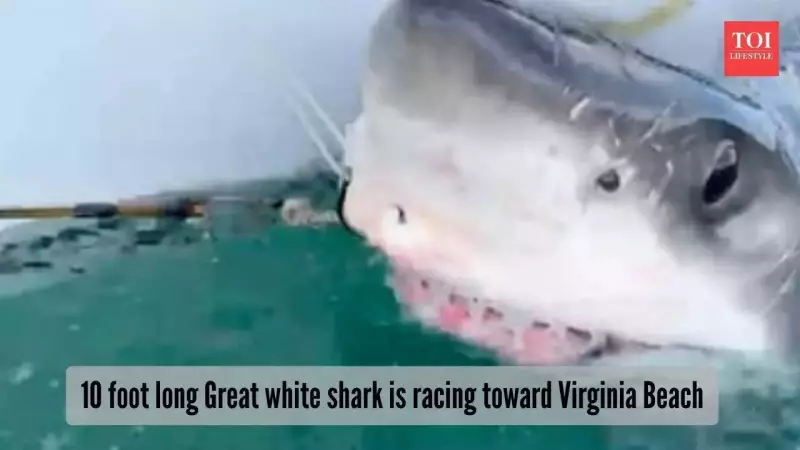
A massive 10-foot-long great white shark, weighing approximately 700 pounds (317 kg), is making waves as her southward journey brings her close to the popular shores of Virginia Beach. Named Bella, this juvenile predator's migration is being followed in real-time by scientists and the public alike, offering a fascinating glimpse into the hidden lives of these ocean giants.
Bella's First Tracked Migration South
Bella was tagged by the marine research organization OCEARCH in Nova Scotia in July 2025. According to reports, she is now on her first documented migration south for the cooler months. Recently, she was detected moving from the Montauk area towards the Chesapeake Bay. Her latest satellite 'ping' placed her about 20 miles west of the Fisherman Island National Wildlife Refuge, which is roughly 32 miles northeast of Virginia Beach.
Chris Fischer, a renowned marine biologist and founder of OCEARCH, provided these details. He noted that Bella is among the later migrants this season, with most other tagged white sharks already south of Cape Hatteras. "This is her first trip south that we're actually able to track her and see how and where she's moving," Fischer stated. Impressively, Bella covered the distance from Montauk to the Chesapeake Bay region in just the past week, demonstrating the remarkable speed of these animals.

What Bella's Journey Tells Scientists
Bella's rapid movement provides fresh data on how white sharks utilize the Northwest Atlantic in late fall and early winter. Her behavior shows that individual sharks can have different patterns even within a broader migration trend. Fischer observed that she has been "moving fast" and it will be interesting to see if she pauses near the northern Outer Banks, a known lingering spot for some sharks before continuing further south.
This long-term tracking is invaluable. As Bella matures, scientists hope her movements could eventually help identify elusive white shark mating areas for the very first time, a major breakthrough in marine biology. Researchers also report that about 88% of tagged white sharks spend summer and autumn in Atlantic Canada, while the remaining 12% stay in the Northeastern United States.
Is There a Risk to Beachgoers in Virginia?
Despite the headlines, experts strongly emphasize that Bella's presence is a normal part of the coastal ecosystem and poses minimal risk to humans. Fischer explains that advanced satellite tracking, widely used only since around 2012, has simply made long-standing shark behavior visible to us. "This actually is not rare," he said. "What we are seeing now is normal. We've all been swimming with white sharks all our lives. Nothing's changed. We just know now."
Statistically, shark encounters remain extremely rare. Fischer argues that the fear-mongering era of Jaws is over, with science debunking the myth of great whites as deliberate man-eaters. Worldwide, such incidents number fewer than a dozen annually. His practical advice for swimmers is to stay aware of their surroundings: look for signs of active feeding like bait balls or diving seabirds, and if an area looks like a predator's buffet, simply choose a different place to swim.
The story of Bella is less about danger and more about discovery. It highlights how technology is bridging the gap between humans and the mysterious lives of sharks, fostering understanding instead of fear.






