

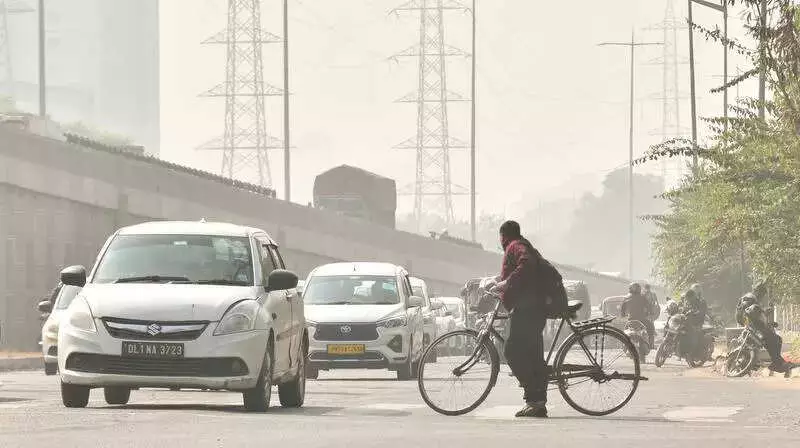
Residents of Gurgaon breathed more toxic air on Thursday as the city's air quality index (AQI) climbed into the higher end of the 'very poor' category. The situation marked a continued decline from earlier in the week, with meteorological conditions creating a lid over the region.
Steady Deterioration in Air Quality
Data from the Central Pollution Control Board (CPCB) showed Gurgaon's AQI touched 293 at 4 pm on Thursday. This was a step down from Wednesday's average reading of 282, confirming a worrying upward trend observed throughout the week. Among specific monitoring stations, Teri Gram reported the worst air at 325, followed by NISE GwalPahari at 294. Sector 51 and Vikas Sadan recorded levels of 265 and 293, respectively.
Weather Conditions Trapping Pollutants
Forecasters and officials pointed to typical early December weather patterns as the primary culprit. Calm winds and falling temperatures are preventing the dispersion of pollutants, trapping them near the ground. Winds remained weak, around 10 kmph through Thursday forenoon after reaching up to 18kmph on Wednesday.

An official from the Haryana State Pollution Control Board (HSPCB) stated that the situation is under close watch. "Local conditions are becoming less favourable for dispersion, so even routine emissions are showing up more sharply. We may see further build-up if winds stay weak," the official explained.
Forecast: Cold and Hazy Days Ahead
The India Meteorological Department (IMD) has forecast mainly clear skies with mist or haze at night. Maximum temperatures are expected to stay between 22 and 24°C on Friday, which is below normal. Winds will continue from the northwest at up to 15kmph in the afternoon before slowing down again in the evening.
The coming days are likely to bring colder mornings and persistent pollution. Saturday is expected to see shallow morning fog with minimum temperatures plunging to 4-6°C. Similar cold conditions with morning fog are predicted for December 5 and 6. A slight gradual rise in temperature is anticipated only by December 7.
Why Relief is Unlikely Soon
Technical parameters indicate that pollution will be hard to clear. The mixing depth—the vertical height available for pollutant dispersion—is expected to remain low at around 1000 metres on December 4 and 5, dropping to 750 metres on December 6. The ventilation index will be between 4500 and 6000 m² per second. Experts note that any value below 6000 m² per second, combined with winds under 10 kmph, is considered highly unfavourable for dispersing pollutants.
Consequently, authorities predict that air quality will remain in the 'very poor' category from December 4 to 7. The extended outlook for the following six days also indicates 'very poor' conditions, offering little hope for immediate improvement.
In a related development, Delhi experienced its coldest morning of the season on Thursday, with the minimum temperature dropping to 5.6 degrees Celsius. Interestingly, despite the cold, Delhi's air quality saw some marginal improvement within the 'very poor' band due to stronger winds, recording an average AQI of 304 at 4 pm against 342 on Wednesday.






