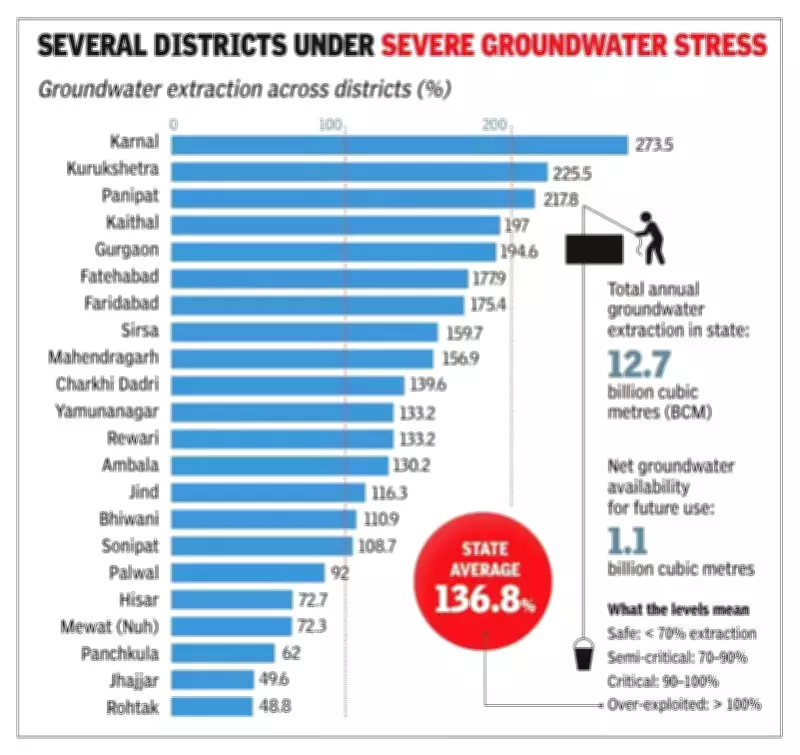
Gurgaon's Groundwater Extraction Remains Alarmingly High at 194.6% Above Sustainable Limit
The city of Gurgaon continues to face a severe groundwater crisis, with extraction rates reaching 194.6% more than the permissible sustainable limit, according to the latest National Compilation on Dynamic Ground Water Resources of India, 2025. This report, released by the Central Ground Water Board (CGWB), reveals a persistent and concerning gap between water withdrawal and natural replenishment.
Persistent Over-Exploitation Despite Slight Improvement
While the current extraction rate shows a marginal improvement from 2024's 195%, the change is negligible and does little to alleviate the critical situation. In 2023, the figure was even higher at 212%, indicating a long-term pattern of unsustainable water usage. The report details that Gurgaon drew 40,396 hectare-metres (ham) of groundwater against a sustainable extractable resource of only 22,923 ham.
Groundwater extraction beyond 100% is categorized as "over-exploited," meaning aquifers are being depleted faster than they can naturally refill. To put this in perspective, one hectare-metre equals 10 million litres of water. This means Gurgaon is extracting approximately 403 billion litres annually, nearly double what its aquifers can sustainably provide.

Widespread Groundwater Stress Across Haryana
The crisis extends beyond Gurgaon, with several Haryana districts reporting severe groundwater stress:
- Karnal recorded the highest extraction level at 273.5%
- Kurukshetra followed at 225.5%
- Panipat reached 217.8%
- Other concerning districts include Fatehabad (177.9%), Faridabad (175.4%), Mahendragarh (156.9%), and Ambala (130.2%)
However, some districts remain in relatively safer categories, with Rohtak at 48.8%, Panchkula at 62%, Jhajjar at 72.7%, and Nuh at 72.3% extraction rates.
Industrial Demand Drives Excessive Extraction
The data reveals that industrial demand forms a significant portion of Gurgaon's groundwater extraction. Of the total withdrawal:
- Approximately 17,142 ham is attributed to industrial use
- Around 5,191 ham is used for domestic consumption
- Irrigation accounts for over 21,267 ham, largely in peri-urban villages
Groundwater recharge in the region depends heavily on rainfall, with monsoon rains contributing about 9,567 ham of recharge. Other sources such as canals and return flows add around 7,002 ham, while non-monsoon rainfall contributes only about 3,206 ham.
Statewide Assessment Reveals Critical Situation
Haryana's overall groundwater situation remains precarious. The state has an annual extractable groundwater resource of about 9.3 lakh ham, but actual extraction is estimated at around 12 lakh ham. The CGWB assessment evaluated 143 groundwater assessment units across Haryana, with alarming results:
- 88 units (61.5%) were classified as "over-exploited"
- 11 units were categorized as "critical"
- 8 units fell into the "semi-critical" category
- Only 36 units (25.1%) were classified as "safe"
Multiple Factors Contribute to Water Crisis
Experts attribute the pressure on aquifers to rapid urbanization, industrial activity, and population growth, which have sharply increased water demand. Large parts of Gurgaon continue to rely on private borewells, particularly in industrial areas, commercial establishments, and residential colonies where piped water supply remains inadequate.
The city currently receives about 570 million litres per day (MLD) of treated surface water, which falls significantly short of its peak summer demand of approximately 675 MLD. This shortage forces residents and industries to increasingly depend on groundwater, exacerbating the depletion problem.
Regulatory Warnings and Enforcement Challenges
This crisis persists despite repeated warnings from the National Green Tribunal and environmental activists about natural resource depletion. Nearly two weeks ago, the tribunal criticized the Haryana government for failing to curb rampant illegal groundwater extraction. It ordered inspections of construction sites, farmhouses, industrial units, educational institutions, and pharmaceutical units to check for illegal borewells.

The situation highlights the urgent need for comprehensive water management strategies, stricter enforcement of extraction regulations, and investment in alternative water sources to address Gurgaon's and Haryana's growing water security challenges.