Gurgaon's January Air Quality Plummets to Nine-Year Low, Sparking Health Alarms
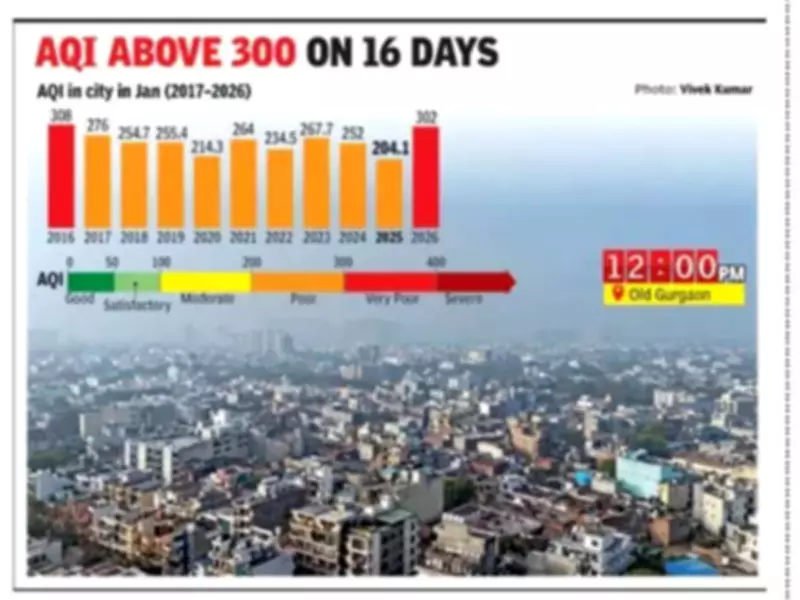
The city of Gurgaon has witnessed its most polluted January in nearly a decade, with air quality deteriorating to alarming levels throughout the month. Data reveals a grim picture: there were zero days classified as 'satisfactory' or 'good,' only two 'moderate' days, and the Air Quality Index (AQI) breached the 300 mark on a staggering 16 days. One of these days saw readings nearing 400, indicating extremely hazardous conditions.
Monthly Average AQI Soars to 302, Surpassing Previous Peaks
The monthly average AQI for January settled at 302, firmly placing it in the 'very poor' category. This figure represents a sharp spike compared to recent years. Historical data shows January averages of 308 in 2016, 276 in 2017, and a previous peak of 263.9 in 2021. The most recent comparison highlights a dramatic worsening from January 2025's average of around 204. This year's average of 302 not only exceeds the 2021 peak but marks the highest January level in at least eight winters, effectively erasing improvements observed in recent years.
Expert Warns of Environmental Crisis and Health Risks
Dr. Kuldeep Kumar Grover, Head of Critical Care and Pulmonology at Gurgaon's CK Birla Hospital, emphasized the severity of the situation. "The absence of 'satisfactory' air days indicates that this is no longer a winter season problem but a serious environmental crisis," he stated. "A monthly average AQI of 302 and several days around 350-400 means the city breathed life-threatening air for extended periods without recovery. This heightens risks of respiratory infections, asthma attacks, heart issues, strokes, and chronic lung damage, especially for vulnerable groups like children and the elderly." He called for immediate emission controls, enhanced public health warnings, and long-term urban air quality planning.

Prolonged Polluted Spells and Contributing Factors
Prolonged polluted spells dominated the middle and latter half of January, with readings consistently hovering above 350. Analysts attribute this surge to a combination of adverse winter meteorology and persistent local emissions. Key factors include:
- Low wind speeds and temperature inversions trapping pollutants near the ground.
- Suspended road dust from construction activities and damaged road surfaces.
- Vehicle emissions and regional pollution sources like waste burning.
A senior official from the Haryana State Pollution Control Board noted, "Unless emission control is strengthened across sectors, winter pollution will remain stubborn." On several days, all monitoring stations in Gurgaon reported 'poor' to 'very poor' air simultaneously, with spikes worsening during calm wind conditions.
Historical Trends Highlight Steep Deterioration
January averages over the years underscore the steep spike in 2026:
- 2018: Approximately 255
- 2019: Approximately 255
- 2020: Dipped to nearly 214
- 2021: Rose to around 264
- 2022: Fell to roughly 234
- 2023: Climbed to about 268
- 2024: Hovered near 252
- 2025: Dropped to around 204
- 2026: Jumped to 302
This trend indicates that extreme winter air pollution is becoming the norm rather than an exception, raising concerns about sustained action on transport emissions, dust control, and regional coordination. Neighboring NCR cities, including Delhi, also experienced sustained 'very poor' air quality, highlighting a broader regional crisis.