

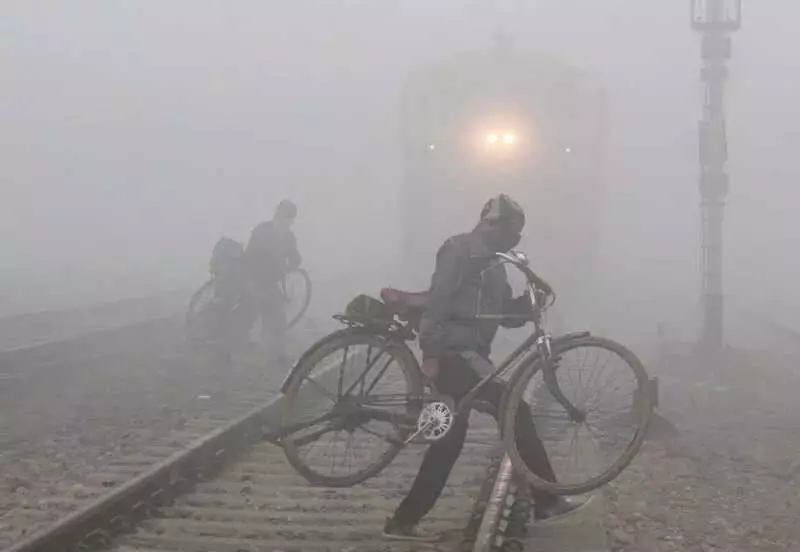
Residents across Haryana struggled for clean air on Monday as the state, particularly the National Capital Region (NCR), was engulfed by hazardous pollution levels. Gurugram, often called the millennium city, recorded a severe Air Quality Index (AQI) of 345, setting a grim tone for the day.
Widespread Poor Air Quality Grips the State
Data from monitoring stations revealed a distressing picture. Out of 22 districts in Haryana, a total of 17 stations reported bad air conditions. The situation was classified as 'very poor' in six locations where the AQI crossed the 300 mark. These hotspots included Dharuhera (336), Manesar (325), Bahadurgarh (324), Ballabhgarh (328), and Gurugram (345).
Several other cities were not far behind, languishing in the 'poor' AQI category. The list featured Fatehabad (295), Sonipat (285), Rohtak (281), Karnal (273), Charkhi Dadri (253), Mandikhera Nuh (248), Narnaul (216), Jind (215), Faridabad (211), and Panipat (209). Officials pointed to increased traffic movement on Monday as a contributing factor to the deteriorating air quality.

On-Ground Action and High-Level Review
While field teams from urban local bodies and the pollution control board were deployed on roads to oversee measures like anti-smog guns, sprinklers, and road cleaning, a crucial review meeting was held at the Haryana civil secretariat. Chief Secretary Anurag Rastogi led the discussion, assessing the state's progress in combating air pollution in the Delhi-NCR region.
The meeting, aligned with directives from the Commission for Air Quality Management (CAQM) and the Union environment ministry, finalized state and city action plans for 2025-26. Detailed strategies were discussed for NCR municipal corporations, including Gurugram, Faridabad, Sonipat, Karnal, Panipat, Rohtak, and Manesar.
Multi-Pronged Strategy for Cleaner Air
The review highlighted a sustained, integrated approach to tackle pollution sources:
Stubble Management: Haryana's push to curb farm fires through Crop Residue Management (CRM) machinery was a key focus. Since 2018-19, over 1 lakh CRM machines, worth Rs 932 crore, have been provided to farmers at subsidized rates for in-situ management. Ex-situ use is also gaining momentum, with paddy straw being directed to pellet plants, power plants, brick kilns, and biogas units. Operational compressed biogas plants in Jhajjar, Kurukshetra, Ambala, Fatehabad, and Panipat now consume thousands of tonnes of straw annually.
Biomass Co-Firing: Significant progress was noted in thermal power plants within 300 km of Delhi. As of November 2025, all operational units have exceeded 6% biomass co-firing, with at least half being paddy straw. Plants in Khedar, Panipat, Yamunanagar, and Jhajjar reported high consumption. Brick kilns in non-NCR districts have also begun mandatory 20% biomass co-firing.
Electric Mobility Push: The state's electric vehicle programme is accelerating, with 60 e-buses already operational in 10 cities, including Gurugram, Panipat, and Karnal. Approvals are in place for over 800 more e-buses under various models. To cut emissions, old BS-III and BS-IV diesel buses have been moved out of NCR districts.
Dust and Waste Control: NCR cities are deploying mechanized sweepers, sprinklers, and anti-smog guns at identified hotspots. Plans for paving and greening major roads have been submitted to the CAQM. On waste, Haryana aims to clear over 14 lakh metric tonnes of legacy waste by December 2025, except Gurugram where the target is 2028. New waste-to-fuel plants for Gurugram and Faridabad are in the pipeline.
Industrial Compliance: Strict timelines are enforced. Industries must install Online Continuous Emission Monitoring Systems by December 2025, with daily oversight by the pollution board. The meeting also reviewed emission control devices and compliance with power plant norms.

Officials expressed confidence that this time-bound, coordinated approach would yield cleaner air across the NCR, even as winter pollution challenges loom. The meeting underscored that polluting industries have been instructed to pause operations until the stringent GRAP IV measures are officially invoked.





