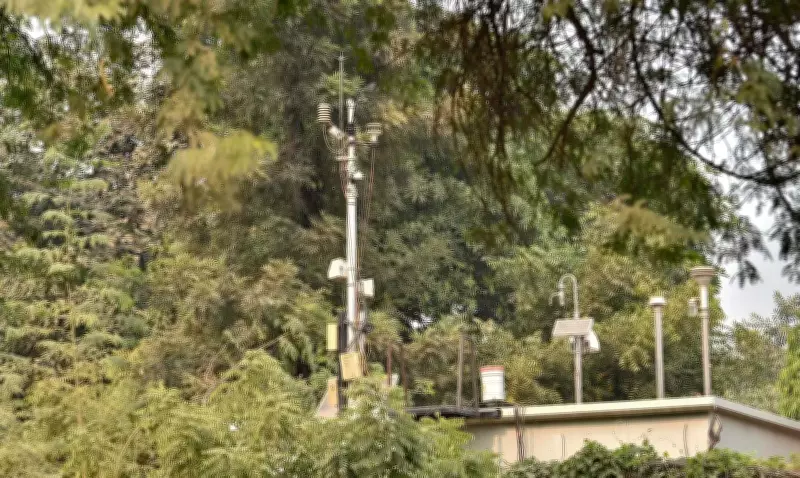
Gurgaon: Haryana has initiated the process of installing 12 new air monitoring stations to enhance pollution surveillance in districts with limited monitoring coverage. The state pollution control board has issued bid documents for the supply, installation, commissioning, and five-year operation and maintenance of these stations. Five stations will be installed in Charkhi Dadri and Mahendergarh each, one in Rewari, and another in Jhajjar.
Current Monitoring Infrastructure
Haryana currently operates 32 Continuous Ambient Air Quality Monitoring Stations (CAAQMS), with the Haryana State Pollution Control Board (HSPCB) managing 29 of them. The additional stations are expected to improve spatial coverage and generate more localized pollution data, addressing gaps in the existing network.
Capabilities of CAAQMS
CAAQMS provide round-the-clock measurements of key pollutants, including PM2.5, PM10, sulphur dioxide, nitrogen oxides, ozone, and carbon monoxide. They also record meteorological parameters such as temperature, humidity, wind speed, and wind direction. This data is used for calculating the Air Quality Index (AQI), identifying pollution hotspots, and assessing compliance with environmental norms.

Addressing Monitoring Gaps
Environmental experts have long pointed to gaps in Haryana's monitoring network, particularly outside major urban centers. Several districts lack real-time air quality data despite concerns over mining activity, industrial emissions, vehicular pollution, road dust, and agricultural residue burning. The addition of 12 new stations is expected to significantly improve pollution surveillance and provide a more representative picture of local air quality conditions.
Benefits of Denser Network
Officials stated that a denser monitoring network would enable authorities to identify pollution hotspots more accurately, assess the effectiveness of mitigation measures, and undertake targeted interventions rather than relying on district-wide averages. The selected agencies will be responsible not only for installation and commissioning but also for operation and maintenance of the stations for five years to ensure uninterrupted data generation and minimize downtime.
Expansion Plans
With this expansion, Haryana is expected to strengthen its real-time air quality monitoring infrastructure as regulators increasingly focus on data-driven pollution management and source-specific interventions. HSPCB member secretary Yogesh Kumar said the state has also been tasked with installing 23 monitoring stations across NCR districts by the end of August. Five are being funded by the Gurugram Metropolitan Development Authority (GMDA), three by the Faridabad Metropolitan Development Authority (FMDA), 10 by HSPCB, and three under the World Bank-supported Arjun project.
NCR and Arjun Project Stations
Officials noted that the two stations proposed in Rewari and Jhajjar are part of the NCR expansion programme. The three stations under the Arjun project, a clean air initiative funded by the World Bank, will be established in Gurgaon, Faridabad, and Sonipat. These stations are expected to provide more advanced monitoring capabilities, helping authorities understand not only pollutant concentrations but also factors contributing to pollution episodes. Kumar added, “The Arjun project stations will provide additional information on pollution sources and reasons behind pollution levels, which will help in better planning and mitigation measures.”