

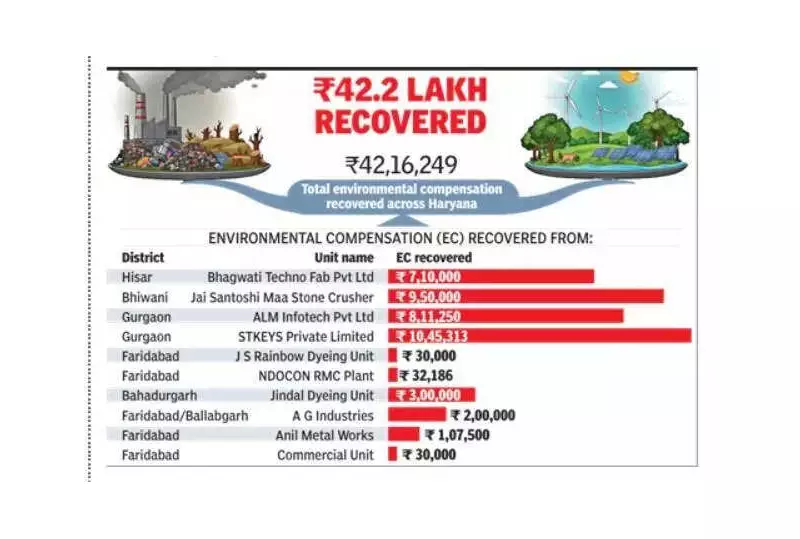
In a stark revelation of weak enforcement, the Haryana government has managed to recover less than one percent of the massive environmental penalties it levied on hundreds of industrial and commercial units over three years. Data shows that while authorities imposed fines exceeding Rs 45 crore, a mere Rs 42 lakh has been collected, leaving a staggering Rs 44.87 crore unpaid.
Mounting Dues and Evasive Violators
This information came to light through a Right to Information (RTI) application, which detailed penalties imposed between 2021 and 2024. The records indicate that only six violators across all districts made any payment. The highest single payment was Rs 10.45 lakh from a company in Gurgaon. Shockingly, nearly every other unit on the list paid nothing despite receiving repeated notices.
Officials cite multiple hurdles in recovering the dues. Many of the offending units have shut down operations, changed ownership, relocated, or legally challenged the penalties. This has significantly slowed down enforcement actions and allowed the outstanding amount to balloon.

Major Defaulters: From Stone Crushers to Textile Units
A significant portion of the pending dues originates from stone crushers and illegal mining units in districts like Charkhi Dadri, Mahendragarh, Bhiwani, Faridabad, and Jind. Individual liabilities for these units, which are major sources of dust pollution and land degradation, range from Rs 7 lakh to Rs 40 lakh.
Another substantial group of defaulters includes textile dyeing and washing units in Gurgaon, Faridabad, and Panipat. Most were fined Rs 14.26 lakh for operating without consent, discharging untreated wastewater, or repeatedly ignoring closure orders.
The list of penalized entities is diverse, also featuring:
- Ready-mix concrete plants
- Banquet halls and marriage lawns
- Hotels and warehouses
- Foundries and construction projects
Some of these face massive penalties of Rs 85 lakh to over Rs 1.2 crore for violations including uncontrolled dust emissions, illegal borewells, unauthorized expansion, and poor waste management.
Beyond Revenue: A Blow to Environmental Restoration
Experts warn that the impact of non-recovery extends far beyond a simple loss of state revenue. The core purpose of Environmental Compensation (EC) is to fund the restoration and remediation of the very sites damaged by pollution. The failure to collect these fines directly hinders the healing of degraded land, water, and air.
This critical gap has now drawn the attention of the National Green Tribunal (NGT). In a recent hearing, the tribunal was informed that the total outstanding EC across Haryana is nearly Rs 230 crore, a figure much larger than the amount revealed in the RTI for specific districts. The NGT observed that the allegations raise a "substantial question relating to environment" and has sought detailed replies from the Haryana government and the State Pollution Control Board by February 13.
Confronted with the poor recovery rate, a senior Haryana State Pollution Control Board (HSPCB) official stated that teams have now been instructed to employ more aggressive measures. "We are aware that recovery has been slow, especially in cases where units have shut down or moved operations. Teams have now been instructed to use revenue-recovery measures, including property attachment, and to pursue pending cases more aggressively," the official said.






