

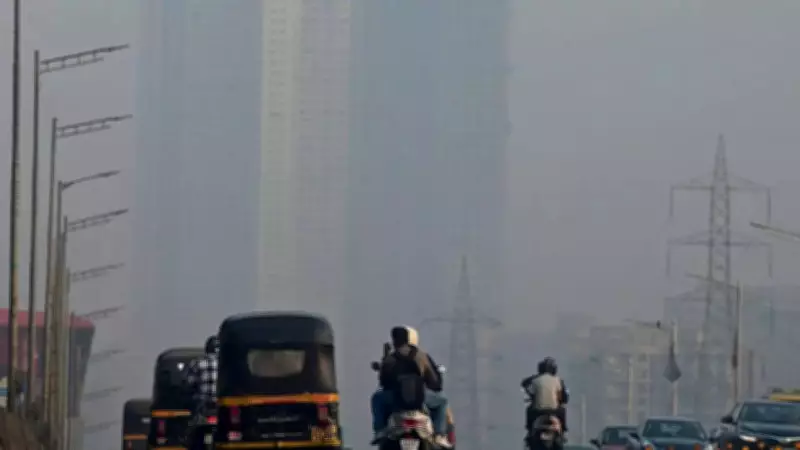
India's Air Quality: Marginal Gains Amid Persistent Pollution Crisis
According to the latest World Air Quality Report released on Tuesday, India recorded a slight improvement in air quality during 2025, but cities across the nation—including Mumbai—continue to struggle with pollution levels that far exceed global safety standards. The annual average concentration of PM2.5 in India decreased by 3% to 48.9 micrograms per cubic meter (µg/m³), yet this figure remains nearly ten times higher than the World Health Organization's recommended guideline.
Global Ranking and Regional Crisis
India now holds the position of the sixth most polluted country worldwide, trailing behind Pakistan, Bangladesh, Tajikistan, Chad, and the Democratic Republic of the Congo. This ranking underscores the immense challenge that persists despite incremental progress. The situation is particularly dire across Central and South Asia, where 17 of the world's 20 most polluted cities are located. Furthermore, the 25 most polluted cities globally are concentrated in India, Pakistan, and China, with India hosting three of the four worst-affected urban centers.
Six Indian cities, including Delhi and Ghaziabad, appear among the 11 most polluted cities worldwide. Cities such as Dhaka, Delhi, and Dushanbe experienced at least two months with PM2.5 levels surpassing 100 µg/m³, highlighting the severe exposure risks in densely populated urban areas.

India's Most Polluted City and Monitoring Infrastructure
Within India, Loni in Uttar Pradesh emerged as the most polluted city, recording an annual average PM2.5 concentration of 112.5 µg/m³. This level is over 22 times the WHO limit and represents a sharp increase of nearly 23% from 2024, following extreme pollution episodes. Although Mumbai did not rank among the worst-polluted cities, it continues to face episodic spikes in pollution linked to road dust, infrastructure projects, and vehicular emissions, especially during winter inversion periods.
The report is based entirely on ground-level PM2.5 measurements collected from a combination of government-operated monitoring stations and low-cost sensors managed by academic institutions, non-profits, and citizen scientists. This approach ensures real-time and locally representative data. The analysis classifies urban and semi-urban habitations as "cities" and employs population-weighted averages to assess national exposure levels.
PM2.5—fine particulate matter smaller than 2.5 microns—remains the primary pollutant tracked due to its severe impact on human health. It originates from various sources, including vehicular emissions, industrial activities, crop burning, dust storms, and residential fuel use.
Monitoring Gaps and BRICS Comparison
The report highlights that India possesses the most extensive air quality monitoring network in the region, yet significant gaps persist, particularly in rural areas. Nearly half of the monitoring stations in South Asia are government-operated, with the remainder relying on community and low-cost sensors.
Globally, BRICS nations present a mixed picture regarding air quality. China has demonstrated sustained improvements in urban air quality over the past decade, while India continues to grapple with structural issues such as construction dust and vehicular emissions. Brazil and South Africa perform relatively better on annual averages but contend with localized industrial pollution hotspots.
Policy Challenges and Health Impacts
Policy gaps remain a critical concern. Despite the National Clean Air Programme's objective to reduce pollution by up to 40% by 2026, nearly two-thirds of allocated funds have been directed toward road dust control. There has been limited focus on addressing industrial emissions and biomass burning, which are major contributors to fine particulate pollution.
The health consequences of poor air quality are becoming increasingly evident. The report cites a surge in respiratory and cardiac cases during extreme pollution episodes, reminiscent of scenes witnessed in Delhi in November 2025, when hazardous air triggered public protests and emergency restrictions.

Future Risks and Urban Planning Warnings
Urban planners and environmentalists caution that without more targeted interventions—especially those aimed at PM2.5 sources—cities like Mumbai risk descending into the same severe pollution trajectory as their northern counterparts. The need for sharper, more effective measures to combat air pollution is urgent to safeguard public health and environmental sustainability.





