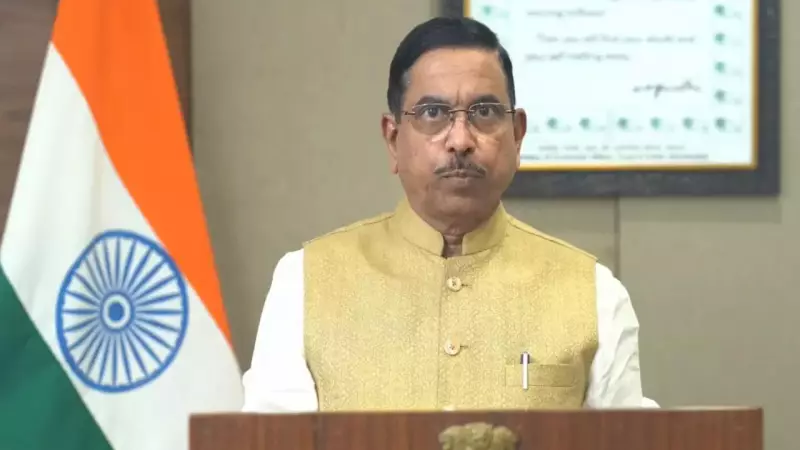
India has achieved a monumental milestone in its green energy journey, recording its highest-ever annual addition of clean energy capacity. Union Minister for New and Renewable Energy, Pralhad Joshi, announced on Friday that the country added a staggering 31.25 gigawatts (GW) of non-fossil power capacity in the current financial year so far.
Solar Power Leads India's Renewable Energy Surge
This record-breaking expansion was overwhelmingly driven by solar energy, which alone contributed 24.28 GW of the new capacity. This underscores solar power's central role in India's ambitious renewable energy strategy. Speaking at the Global Energy Leaders' Summit 2025 in Puri, Odisha, Minister Joshi positioned India as a key driver of the worldwide renewable energy acceleration.
He provided a striking comparison of global progress: while it took nearly 70 years for the world to reach the first terawatt (TW) of renewable capacity by 2022, the second TW was added in just two years, by 2024. India's contribution to this rapid growth has been significant. Between 2022 and 2024, the nation added 46 GW of solar capacity, making it the world's third-largest contributor to global solar installations.

From 2.8 GW to 130 GW: A Decade of Solar Transformation
Minister Joshi highlighted the extraordinary scale of India's solar transformation over the past decade. The country's solar capacity has exploded from a mere 2.8 GW eleven years ago to approximately 130 GW today. This represents a growth of more than 4,500 percent.
He acknowledged India's position as the holder of the world's fifth-largest coal reserves and its status as the second-largest coal consumer. However, he emphasized that the nation is increasingly striking a balance between fossil fuels and renewables as the energy transition gathers momentum. Joshi stated that clean energy has become strategically critical amid evolving pressures from global trade and industrial competitiveness.
New Initiatives for Odisha and a Robust Growth Ecosystem
Announcing fresh clean energy initiatives specifically for Odisha, the minister revealed that the Centre has approved a consumer-owned Utility-Led Aggregation (ULA) model under the PM Surya Ghar scheme. This model aims to install 1.5 lakh rooftop solar systems, each of 1 kW capacity, across the state. The programme is projected to benefit nearly 7 to 8 lakh people, with a focus on economically weaker households.
Joshi noted that Odisha already boasts over 3.1 GW of installed renewable capacity, with clean energy constituting more than 34% of the state's total installed power capacity. Under the PM Surya Ghar Yojana, around 1.6 lakh households in Odisha have applied for rooftop solar installations, with over 23,000 installations completed to date. More than 19,200 families have received subsidies exceeding Rs 147 crore directly into their bank accounts.
The minister attributed India's remarkable renewable energy expansion to a supportive ecosystem built on several pillars:
- Policy reforms
- Ease of doing business
- Strong investor confidence
- Demand-driven government schemes
- Effective cooperation between the Centre and State governments
Expressing strong confidence in Odisha's potential, Joshi stated that the state is poised to play a leading role in the next phase of India's green growth story. This record capacity addition marks a decisive step towards the nation's climate and energy security goals.