

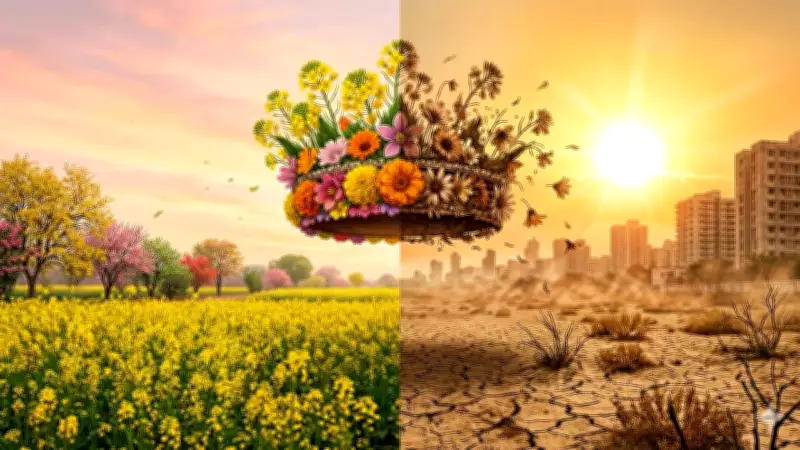
India's Spring Season Vanishing as Climate Change Accelerates Early Heat
There was a time when March in India represented a gentle pause between seasons. Not quite winter, not yet summer. It was the season of light shawls, flowering trees, cool evenings, and that brief, forgiving softness between two climatic extremes. Now, across much of the country, that seasonal pause appears to be disappearing.
The Disappearing Transition
Fans return too early. Sweaters are packed away too soon. Afternoons begin to sting by late February, and by early March, in many cities, the sun already feels like a warning. The calendar may still insist it is the season of flowers, but the skin knows better: this is already the season of heat.
This week, parts of north India briefly experienced a return to spring-like conditions. Rain, cloud cover, and gusty winds brought a sudden temperature drop across several cities, including Delhi, offering short-lived respite. For a day or two, the air softened and the sun retreated. Yet this momentary relief only highlights the larger, disturbing pattern.

Across India, winters are warming, heat is arriving earlier, and the fragile transition once called spring is becoming shorter, sharper, and less reliable. In the popular imagination, "Winter is Coming" was a chilling omen. In modern India, the tragedy is reversed: winter comes late, stays briefly, and is cut short before fully retreating.
Why the Loss of Spring Feels Personal
In India, spring was never merely a pleasant interval. It was a season with deep memory, meaning, and cultural weight. In Indian literary imagination, it is often called Rituraj—the king of seasons—the brief, beloved interlude of blossom, breeze, and balance.
Few modern lines capture the unease of changing seasons as hauntingly as Gulzar's words: "Mausam beghar hone lage hain"—the seasons have begun to become homeless. Long before climate science provided charts and anomalies, Indian tradition honored spring. In the Bhagavad Gita, Lord Krishna declares, "Ritunam Kusumakarah"—among seasons, I am spring, the flower-bearing season.
The loss feels intimate because what is under strain is not just a season, but a cherished part of Indian life—mustard fields, flowering trees, open windows, exam mornings, festival air, and the first real relief after winter. In a warming India, that king appears to be losing ground.
Data Confirms the Climate Shift
This is not mere nostalgia. India's weather data increasingly shows winters running warmer, heat arriving earlier, and the short bridge once called spring under growing pressure. In late February this year, the India Meteorological Department warned that an above-normal number of heatwave days is likely across most parts during March to May.
That warning follows a disturbingly familiar pattern. 2024 was India's warmest year on record since 1901, with annual mean land surface temperature 0.65°C above the 1991–2020 average. Then came 2025, which IMD identified as the eighth warmest year since 1901. One hot year can be dismissed as anomaly; two consecutive hot years suggest a pattern; a decade of them feels like a new climate.
Somewhere in that shift, India's most delicate season appears to be getting squeezed out.
A Season Built on Balance—And Why That Balance Is Breaking
India never had Europe's dramatic four-season calendar. Spring here was always more delicate, regional, and atmospheric than official. It arrived differently in Delhi, Kolkata, Lucknow, Bengaluru, and the hills. It was a season of transition, which makes it particularly vulnerable.
Spring survives on a narrow window between retreating winter and advancing summer. It needs winter to linger just long enough and summer to wait just long enough. When winters grow warmer and heat arrives earlier, that window shrinks. The result is not just a hotter March, but a shorter, more abrupt transition.
Climate Central's 2024 analysis found that in many northern states, slight cooling in January is now followed by sharp warming in February, creating potential for an abrupt jump into traditionally March conditions. Spring may still exist on the calendar, but in many places, it is fading from lived experience.

Warning Signs from Recent Years
Before 2026's heat alerts, 2025 already demonstrated how fragile the transition season had become. IMD reported February 2025 as the warmest February in India since record-keeping began in 1901. The same outlook warned that March–May 2025 would likely see above-normal heatwave days across most parts.
Rainfall patterns also showed stress. All-India rainfall in February 2025 was 10.9 mm, the 18th lowest since 1901. Late-winter and early-spring moisture helps keep land surfaces cooler; a dry February primes the ground for hotter weeks ahead. New research confirms this link, showing that low soil moisture weeks before a heatwave is a major precondition for high temperatures in north-central India.
2026 Makes the Pattern Harder to Ignore
This year's forecast carries significant implications. According to IMD's March–May outlook, above-normal heatwave days are expected over most parts of India, including West Rajasthan, Gujarat, Haryana, Punjab, Maharashtra, Uttar Pradesh, Bihar, Jharkhand, West Bengal, Odisha, Chhattisgarh, Telangana, Andhra Pradesh, and parts of Karnataka and Tamil Nadu.
Simultaneously, IMD noted that maximum temperatures in March might initially be normal to below normal in many parts, partly because March rainfall was expected near normal. This apparent contradiction reveals a deeper story: the climate is becoming more volatile. Brief cool spells or stray showers can temporarily pull temperatures down, even as the seasonal baseline keeps climbing.
IMD's live warnings in March already flagged heatwave to severe heatwave conditions over Gujarat in mid-March. This is what a disrupted spring increasingly looks like: not a smooth transition, but a tug-of-war between abrupt heat spikes and sudden weather breaks.
The Himalayas: India's Climate Wall Under Strain
If India has a weather buffer, it is the Himalayas. They are not just a landscape; they are a climate engine. Snowpack, winter precipitation, and western disturbances shape how much cold air, moisture, and seasonal moderation travel into the plains.
That wall is under stress. In 2025, the Hindu Kush Himalayan region recorded its lowest snow persistence in 23 years, according to the International Centre for Integrated Mountain Development. Seasonal snow persistence was 23.6% below normal—the third consecutive below-normal snow year.
For India, the details are crucial. The Ganga basin saw snow persistence 24.1% below normal, the lowest in 23 years. Seasonal snowmelt contributes about 23% of total annual water flow in major river basins across the Hindu Kush Himalaya. Less persistent snow means earlier melt, lower late-season buffering, and more stress on downstream water systems.
Environmentalist Kavita Ashok, president of Tree For Life, pointed to weak western disturbances this winter, noting that lower rainfall and snowfall may have contributed to a sharper, less forgiving transition in the plains.
When the Body Notices Before Instruments Do
Climate change is often explained in charts, but people usually feel it first in the body. You feel it when February afternoons resemble April, when school assemblies grow harsher, when weddings move indoors sooner, when park walks shrink, and when Holi begins to feel less like winter's end and more like summer survival's beginning.
What disappears with spring is not just comfort, but a familiar way of moving through daily life. You can sometimes see the disruption in city colors. The semal still erupts in red, bougainvillaea still spills over walls, amaltas still waits for its golden turn, and gulmohar still readies its annual blaze. But the old sequence feels less certain. Flowers return, yet the air around them is different.
A recent Time report noted that India's cities are warming nearly twice as fast as rural areas because climate change and urbanization intensify the urban heat island effect. Spring is being squeezed from two sides: by a warming planet and by hotter, denser, concrete-heavy cities.
How Indian Cities Accelerate Spring's Disappearance
Not every lost season is lost only to carbon emissions. Some disappearance is being paved over. The modern Indian city excels at trapping heat through dark roads, glass facades, fewer trees, disappearing wetlands, exposed concrete, traffic, generators, AC exhaust, dense construction, and shrinking breathable public space.
Ashok links the disappearing feel of spring to urban expansion, concrete-heavy cityscapes, and shrinking green cover, all of which trap heat and make Indian cities feel warmer faster. "Climate change and global warming are creating ripples of heat across the globe. This could be attributed to urban expansion, concrete cities, and depleting forests and green cover," she said.
This explains why even when a city gets a pleasant afternoon breeze, nights may stay uncomfortably warm. Hotter nights are among the clearest signs that a place is shifting climate, not just experiencing weather. IMD's 2026 outlook warns that minimum temperatures are very likely above normal over most parts during March to May.
Farmers Feel the Loss First—And Harder
For urban dwellers, spring's disappearance may mean discomfort. For farmers, it can mean damage. The winter-to-summer bridge is critical for wheat, mustard, chickpea, rapeseed, horticulture, and flowering cycles. A premature heat surge during grain filling or maturation can cut yields.
IMD flagged concern in 2025 that warmer late winter and above-normal heat could affect winter crops during their maturing phase. That concern has returned for 2026. Reports from Punjab this month indicated maximum temperatures running about 7.5°C above normal in early March, raising fresh worries for standing wheat. What looks like a vanished spring in the city yields stress in the field.
Not the End of Spring—But the End of Trusting It
It would be inaccurate to declare spring "gone" from all of India. The country is too large, varied, and topographically complex. Some southern plateau regions retain more gradual transitions in certain years. Some hill regions still offer recognizable spring. Some years still deliver generous March conditions.
The real story is fragmentation. Spring is becoming shorter in many places, less reliable, more regionally uneven, more easily interrupted by extreme heat, and less socially legible. Seasons are not just meteorological categories; they are cultural expectations. When people stop trusting a season to behave like itself, that season begins to lose meaning.
What the Fading of Rituraj Really Warns Us About
Concern about spring may sound soft, but it actually concerns systems: warmer winters, drier soils, stressed snowpack, volatile transition months, urban heat islands, crop risk, rising night temperatures, and a country learning that climate change does not always arrive as spectacular disaster.
Sometimes it arrives as the disappearance of something subtle. Not a flood, cyclone, or headline-grabbing heatwave—at least not initially. Sometimes it arrives as the quiet shortening of a season that once taught the body how to move from cold to heat.
Rituraj was India's brief season of balance—a pause between extremes that people quietly built routines around. When that season becomes shorter, harsher, and less reliable, the loss is not only meteorological. It touches memory, habit, and the texture of everyday life.
Spring has not vanished from the calendar. But in a warming India, it is fading from lived experience, overtaken too often and too early by the heat of a season that now refuses to wait. And that is not just weather. That is a warning.





