

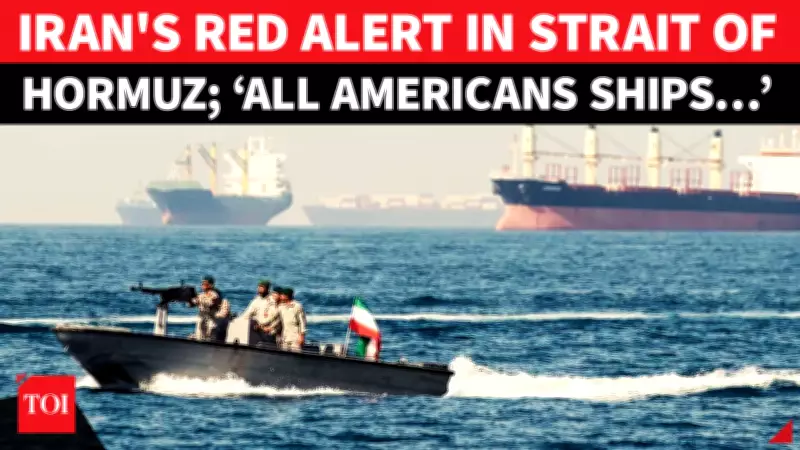
Iran Issues Stark Warning to US Over Persian Gulf Access
In a dramatic escalation of tensions in the Middle East, a senior Iranian official has declared the Persian Gulf off-limits to American ships, specifically threatening to keep the strategically vital Strait of Hormuz closed. Mohsen Rezaee, a key member of Iran's Expediency Discernment Council, delivered the provocative statement, signaling a significant hardening of Tehran's stance against perceived US hegemony in the region.
'Strait of Hormuz Will Not Be Opened'
Mohsen Rezaee asserted that no American vessel has the right to enter the Persian Gulf waters, framing the declaration as a direct challenge to US naval power. "The Strait of Hormuz will not be opened," he stated unequivocally, referring to the narrow chokepoint through which approximately one-fifth of the world's oil passes daily. This move represents a bold attempt by Iran to assert control over one of the globe's most critical maritime trade routes.
Rezaee claimed that Iran has already succeeded in breaking "American hegemony" in the Gulf region. He argued that the ongoing confrontation could fundamentally alter the regional balance of power, potentially shifting influence toward Tehran while simultaneously weakening the United States' strategic position. This rhetoric underscores Iran's confidence in its asymmetric capabilities and its willingness to engage in a high-stakes geopolitical standoff.

Global Energy Markets Face Turbulence
The Iranian official issued a grave warning about potential disruptions to global energy markets, predicting severe consequences from the escalating conflict. He dismissed the effectiveness of the United States releasing oil from its strategic petroleum reserves, suggesting such measures would only provide temporary price stabilization. Rezaee forecasted a "potential massive spike" in oil prices in the near future, which could trigger economic instability worldwide and increase inflationary pressures on consumers and industries dependent on hydrocarbon fuels.
This warning highlights how regional tensions in the Persian Gulf have immediate and far-reaching implications for the global economy. Any sustained closure or significant disruption of shipping through the Strait of Hormuz would likely cause oil prices to skyrocket, affecting everything from transportation costs to manufacturing and household energy bills across continents.
Demand for US Withdrawal as Condition for Security
Rezaee concluded his remarks by outlining Iran's fundamental demand for long-term security in the Persian Gulf region. He insisted that genuine and sustainable stability would only be achievable if United States military forces completely withdraw from the area. This condition reflects Iran's longstanding position that American presence constitutes an occupation and a source of instability, rather than a stabilizing force.
The declaration represents a significant escalation in rhetoric from Iranian authorities, moving beyond previous warnings to an explicit ban on US naval access. It comes amid heightened regional tensions and suggests Tehran is prepared to take increasingly assertive measures to challenge US influence and protect what it views as its sovereign interests in the Persian Gulf. The international community now watches closely to see how Washington will respond to this direct challenge to its freedom of navigation and strategic interests in one of the world's most volatile regions.






