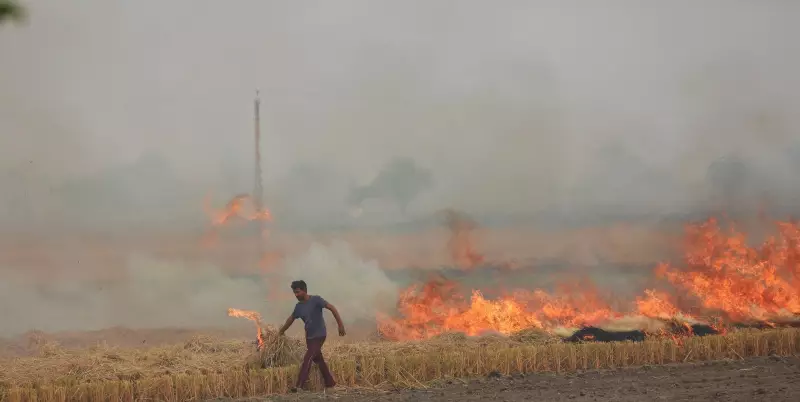
A groundbreaking study by the Indian Space Research Organisation (ISRO) has cast doubt on the official narrative of a steady decline in farm fires in Punjab and Haryana. The research suggests that a deliberate shift in the timing of stubble burning to later in the day is causing a significant undercount of active fire events, potentially skewing pollution data and mitigation efforts.
The Satellite Blind Spot
Conducted by scientists at ISRO's Space Applications Centre in Ahmedabad, the study utilized data from European geostationary satellites, which constantly monitor a fixed region. This contrasts with the polar-orbiting satellites from NASA and NOAA used by Indian government agencies, which only pass over specific areas once or twice a day.
The research, published in the journal Current Science on November 25, 2025, found a clear pattern: peak fire activity in the two states gradually shifted from around 1:30 PM in 2020 to approximately 5:00 PM in 2024. This strategic move aligns with the gaps in surveillance by polar satellites, which leave Punjab and Haryana unmonitored for large windows, particularly between 2:30 PM and 10:30 PM.

Implications for Data and Policy
The findings indicate that the falling numbers of farm fires officially reported may reflect an "underestimation" rather than a genuine reduction. "Our analysis shows a gradual shift in peak fire activity... to avoid detection by polar orbiting satellites," the study states. This has direct consequences for emission inventories, air quality assessments, and the effectiveness of government strategies to curb the practice.
The Commission for Air Quality Management (CAQM) was alerted to this potential data gap by ISRO last year. In an affidavit to the Supreme Court in November 2024, CAQM acknowledged that fires were being detected by a Korean geostationary satellite after NASA's polar satellite had passed. The Commission has since asked Punjab and Haryana to explain methods for counting undetected fires and the punitive actions taken.
Round-the-Clock Ground Response
Punjab officials, speaking on December 4, confirmed awareness of the alleged timing shift. In response, the state has significantly intensified ground monitoring and enforcement efforts. Over 10,500 personnel were deployed this season for 24/7 vigilance, supported by flying squads from the CPCB and CAQM, and a special 1,700-member 'Parali Protection Force'.
"We took steps and created a system of round-the-clock checking so that there is no gap — when the satellites cannot record the fires, our teams on the ground should do so," said a senior engineer with the Punjab Pollution Control Board. A district magistrate from a hotspot area confirmed that special teams now conduct late-evening patrols to catch night-time burning, which some farmers resort to in hopes of avoiding FIRs and environmental compensation.
The penalties have also been increased. This year, fines range from Rs 5,000 for small landholders to Rs 30,000 for those with over 5 acres. Despite the challenges, official data shows a sharp drop: Punjab recorded only 5,114 farm fires from September 15 to November 30, 2025, down from 83,002 in 2020. Haryana reported 662 incidents this year, compared to 6,987 in 2021.
While the ground enforcement appears robust, the ISRO study underscores the critical need to integrate geostationary satellite data for a true picture of stubble burning, ensuring that policy actions are based on complete and accurate information.