

Kendrapada Authorities Launch Major Crackdown on Illegal Shrimp Farms in Bhitarkanika National Park
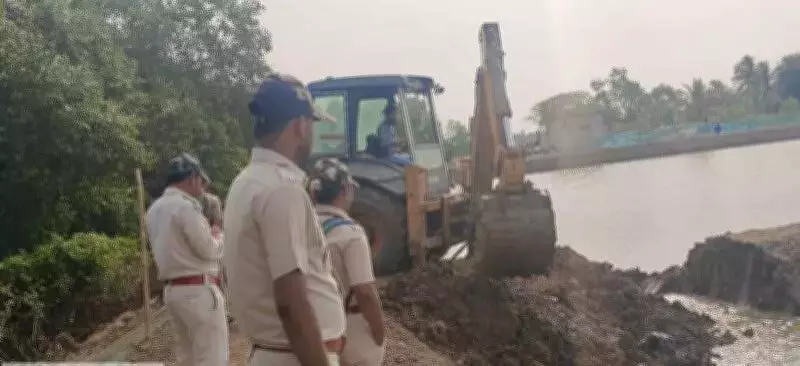
In a significant environmental enforcement action, forest officials in Kendrapada district initiated a large-scale demolition operation on Saturday, targeting illegal shrimp farms located within the ecologically sensitive Bhitarkanika National Park. The crackdown focused on multiple villages including Pataparia, Vekta, Gopaljewpatana, Sailendranarayanpur, and Gumura, marking a decisive move against unauthorized aquaculture activities that have been damaging the region's fragile ecosystem.
Demolition Drive Under Police Protection
Operating under tight police security, officials deployed earth-moving equipment to dismantle gherries (shrimp farming enclosures) covering approximately 12 acres of land. Manas Kumar Das, Assistant Conservator of Forest for Bhitarkanika, emphasized the legal basis for the action, stating, "We will demolish all shrimp farms which violate the Coastal Regulation Zone and the rulings of the Supreme Court and the Orissa High Court." The operation represents a firm implementation of judicial mandates aimed at protecting coastal environments.
Environmental Restoration and Community Impact
Following the demolition, the forest department plans to undertake ecological restoration by planting mangrove saplings on the cleared areas, effectively converting them back into mangrove forests. Das highlighted the severe environmental consequences of these illegal farms, noting that owners routinely discharge untreated effluents into nearby rivers, ponds, and groundwater sources. "Illegal prawn farms also pose a direct threat to the nearby rich mangrove forests," he added, explaining that recent complaints from villagers about destroyed agricultural lands prompted the stern action.

Umesh Chandra Singh, a farmers' leader in Kendrapada, corroborated these concerns, stating that many seaside and riverside communities have been protesting against the proliferation of illegal shrimp farms. The unchecked expansion has rendered fertile farmlands unusable due to contamination from farm effluents, severely impacting local agriculture and livelihoods.
Shrimp Farmers' Discontent and Historical Context
However, the demolition has sparked discontent among shrimp farmers. Narayan Mandal, a farm owner from Pataparia village, defended the practice, arguing, "Paddy cultivation is not a profit-making business in the seaside villages for which we converted our lands into shrimp farms and the officials have no right to take any action against us." This sentiment reflects the economic pressures driving aquaculture conversions in coastal regions.
The issue has deep historical roots, with environmentalist Hemant Kumar Rout, Secretary of Gahirmatha Marine Turtle and Mangrove Conservation Society, pointing out that shrimp mafias have been illegally converting large tracts of mangrove forests and agricultural land into prawn farms since the 1990s, leading to significant forest cover loss. In 2017, the Union Ministry of Environment and Forests declared 192 villages around Bhitarkanika as Eco-Sensitive Zones (ESZs) to prevent ecological damage from developmental activities. "ESZ prohibits any shrimp farming within 2km from Bhitarkanika," Rout emphasized, underscoring the legal framework designed to safeguard India's second-largest mangrove forest.
The ongoing demolition drive in Kendrapada represents a critical juncture in balancing environmental conservation with local economic interests, highlighting the complex challenges of enforcing coastal regulations in ecologically vital areas like Bhitarkanika National Park.






