Madhya Pradesh Vulture Census Reveals Stark Ecological Divide
The statewide three-day biannual vulture census concluded on Sunday, unveiling a dramatic contrast in the health of ecological corridors across the Indore forest division. While dense, protected forests emerged as thriving havens for these critical scavengers, urban-adjacent areas witnessed a troubling exodus and sharp population decline.
Choral Forest: A Biodiversity Success Story
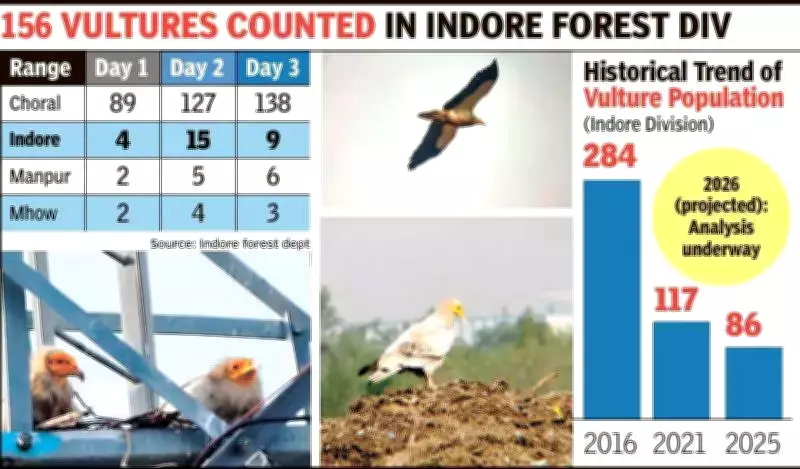
In the Choral forest range, vulture sightings increased steadily over the three-day period, peaking at an impressive 138 on Sunday. Wildlife experts attribute this success to Choral's rich biodiversity and largely undisturbed environment. The high density of prey and wildlife ensures a steady supply of carcasses, creating an ideal habitat where vultures were frequently observed circling the canopy.
"The undisturbed natural ecosystem here provides everything vultures need to thrive," explained one wildlife official, highlighting how protected areas can serve as vital refuges for endangered species.

Urban-Adjacent Areas Face Alarming Decline
In stark contrast, the Indore and Mhow ranges recorded dismal numbers, with Indore barely reaching 15 sightings on its best day. Former forest official Abhay Jain identified multiple man-made factors driving this concerning decline.
"The historical use of Diclofenac remains a primary killer," Jain stated, referring to the painkiller once commonly administered to cattle. Vultures that consumed carcasses of treated cattle suffered fatal kidney failure, decimating populations across South Asia.
Additional factors include the complete removal of waste from the Devguradia trenching ground, which stripped vultures of a major urban food source, forcing migration. Expansion of road and railway projects has led to large-scale deforestation, destroying the tall trees and high cliffs essential for nesting.
"Lack of adequate food and environmental stress significantly lowered the breeding capacity of the surviving population," Jain emphasized, painting a grim picture of urban-adjacent vulture habitats.
Comprehensive Reporting and Conservation Planning
Following the field exercise, the Indore forest division is preparing a comprehensive 10-point report for state headquarters. DFO Lal Sudhakar Singh stated that the report will detail critical metrics including the ratio of adults to juveniles and the number of active nests.
This data will be submitted to the state headquarters on February 23 to formulate a long-term conservation strategy for Madhya Pradesh, potentially including habitat restoration and stricter protection measures.
District-Wide Census Results and Methodology
Across Madhya Pradesh, census results varied dramatically by region:
- Neemuch District: Recorded 507 vultures across Neemuch, Manasa, Rampura, Jawad, and Ratangarh ranges. Under the leadership of SDO forest Dashrath Akhand, the department used a specialized mobile application for the first time to record data accurately.
- Dewas District: Spotted 88 vultures in Udainagar and Hasalpur forest ranges, including one Himalayan griffon and numerous Egyptian vultures.
- Dhar District: Documented only two vultures during the three-day survey, representing a 50% decline from last year's count of four. Dhar DFO Vijaymanthan TR noted that 97 officials were posted across as many forest beats for this minimal result.
To ensure accuracy, census teams followed strict protocols: only vultures perched on trees or cliffs were counted, while those in flight were excluded to avoid duplication.
Gandhi Sagar: A Premier Vulture Paradise
While Indore struggled, Gandhi Sagar Wildlife Sanctuary in Mandsaur cemented its status as Madhya Pradesh's premier vulture hub. A remarkable total of 1,084 vultures were recorded here, representing seven distinct species.
Locally breeding species including long-billed, white-rumped, red-headed, and Egyptian vultures thrive on the towering cliffs along the Chambal river. The sanctuary also hosts migratory giants like the Himalayan griffon, Eurasian griffon, and massive cinereous vulture.

These migratory birds travel thousands of kilometers from Tibet, Central Asia, and the Himalayas, typically arriving in November and staying until April to take advantage of the sanctuary's ideal conditions.
DFO Sanjay Raikhere credited the 120 active nests found in the sanctuary to its human-intervention free zone and the perennial water supply from the Chambal river. "Protected, undisturbed habitats with reliable resources are absolutely essential for vulture conservation," Raikhere emphasized.
The census results highlight both the success of protected sanctuaries and the urgent need for intervention in urban-adjacent areas where vulture populations continue to face multiple threats from human activity and environmental degradation.