

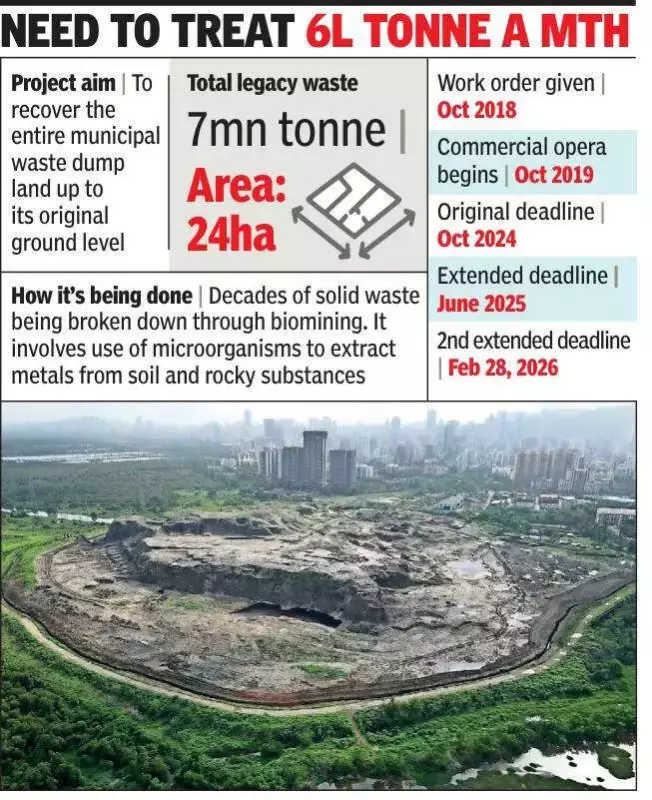
Brihanmumbai Municipal Corporation's (BMC) flagship project to clear the legacy waste at the Mulund dumping ground has hit another roadblock, with the civic body granting a fresh extension to the contractor until February of next year. This marks the latest in a series of delays for the ambitious Rs 731-crore biomining initiative.
A History of Setbacks and Extensions
The Mulund dumping ground was officially closed in 2018 and was subsequently earmarked for a massive bioremediation and biomining project. The work began in 2019 with the goal of processing millions of tonnes of old waste. However, the project's journey has been far from smooth.
Officials cite multiple uncontrollable factors that have slowed progress. The project had already received a one-year extension due to significant disruptions. The Covid-19 lockdown brought operations to a standstill for months, severely affecting the availability of manpower and machinery. Later, in May 2021, Cyclone Tauktae, though it made landfall in Gujarat, passed close enough to Mumbai to dump over 200mm of rain—the city's highest rainfall for that month—causing further delays. This initial extension period concluded in June 2023.

The Latest Hurdle: An Early and Disruptive Monsoon
The most recent slowdown, leading to the current extension, is attributed to the premature onset of the monsoon. Mumbai recorded its earliest-ever monsoon arrival on May 26 this year. This early rain added significant moisture to the mountainous legacy waste piles, making the biomining process unworkable for extended periods.
Biomining relies on specific conditions to be effective. During heavy rain, the waste becomes excessively wet and heavy, complicating the mechanical separation process. High moisture content disrupts the aerobic microbial activity essential for decomposition, turning the waste into a slushy mass that sticks to machinery and causes frequent breakdowns. Furthermore, the segregated output—like soil-like material—turns to mud, recyclables get contaminated, and the overall system gets clogged. The ground conditions also become slippery and unstable, posing safety risks for heavy equipment.
Mounting Pressure and an Unrealistic Target
Despite the new February 2024 deadline, data suggests the contractor faces a nearly impossible task. Out of the total 7.8 million tonnes of legacy waste, approximately 5.8 million tonnes have been treated. This leaves a substantial 2.2 million tonnes still untouched.
The contractor's best monthly performance to date has been around 3.5 lakh tonnes. To clear the remaining waste by the revised deadline, the pace would need to accelerate dramatically to nearly 6 lakh tonnes per month—a target that civic officials themselves admit is unrealistic. The BMC has stated that a penalty will be imposed if the contractor fails to meet this latest deadline.
An official explained the decision, stating, "The project faced unavoidable delays initially. After evaluating the impact of these events, we approved a one-year extension. The contractor also reported increased non-working days this year due to the early monsoon, which was beyond his control. The latest extension was granted after a thorough review of these delays and an assessment of the overall progress."
The repeated extensions highlight the complex challenges of urban waste management and the vulnerability of large-scale environmental projects to climatic uncertainties. All eyes will now be on whether the contractor can mount a final, accelerated push to tackle Mumbai's mountainous legacy waste problem.






