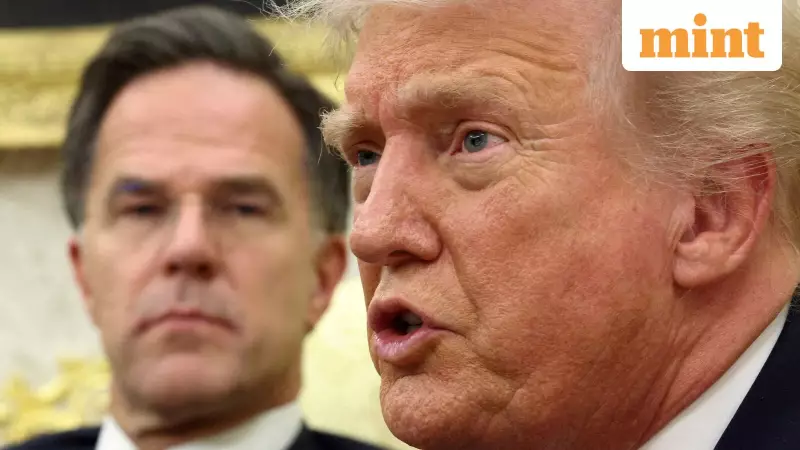
NATO Military Leadership Maintains Focus Amid Political Storm Over Greenland
While political leaders across the Atlantic navigate one of the most serious diplomatic crises in decades, NATO's military commanders have adopted a singular mission: ignore the news and maintain operational readiness. The controversy stems from President Trump's demand that Denmark cede control of Greenland, creating unprecedented trans-Atlantic tensions that have dominated headlines and diplomatic discussions.
The 'Keep Calm and Carry On' Approach at NATO Headquarters
At NATO's Brussels headquarters this week, senior officials opened meetings with a clear message to military personnel: despite the political drama surrounding Greenland, nothing has changed for operational forces. This directive was reinforced across multiple briefings and conversations throughout the alliance's command structure, according to military officers who attended the gatherings.
"We of course are aware of the political discussions that are going on, but there was never a military dimension to those discussions that made its way to us," stated U.S. Air Force General Alexus Grynkewich, NATO's top military commander, following committee meetings. This sentiment was echoed by Committee Chairman Giuseppe Cavo Dragone, an Italian admiral serving as the top military adviser to NATO Secretary-General Mark Rutte, who described this week's military discussions as "totally uneventful" regarding Greenland matters.

Why Military Focus Remains Unwavering
Senior NATO officers emphasize that maintaining this disciplined focus is crucial because militaries function like emergency services—they must be prepared to respond immediately to emerging threats. The alliance, representing approximately one billion people across territories stretching from Alaska to the Black Sea, operates under the constant imperative to be ready to "fight tonight," as commanders frequently describe their readiness posture.
This operational philosophy extends beyond mere rhetoric. NATO and most military organizations deliberately structure their work to be as routine and predictable as possible, scheduling operations months in advance due to the complex planning and logistics required when coordinating forces from 32 different member countries.
Political Noise Versus Military Mission
The challenge of tuning out politically charged news directly related to their work has proven difficult for some NATO personnel. President Trump's recent comments at Davos, where he criticized NATO as treating the United States "very unfairly" and questioned what America has gained from the alliance, created additional tension. NATO defenders counter that the alliance's mutual-defense pact has only been triggered once—to support the U.S. following the September 11, 2001 terrorist attacks—and emphasize the strategic value of America's extensive alliance network.
In a telling demonstration of NATO's "keep calm and carry on" approach, the alliance's committee of national military leaders began their regular meeting on Wednesday precisely as President Trump was speaking in Davos—and deliberately tuned out his remarks, according to attendees.
Continuing Exercises and Future Plans
Despite the political turbulence, NATO military activities continue unabated. The alliance has announced several upcoming exercises, including multiple operations across the Arctic region. Norway recently detailed its Cold Response maneuvers scheduled for March, described as its largest military exercise of the year. Led by a Norwegian-U.S. headquarters near the Arctic city of Bodo, this exercise will bring together approximately 25,000 soldiers from 14 NATO countries, including the United States, Canada, Denmark, Spain, and Turkey, focusing on improving allied cooperation in challenging High North conditions.
Simultaneously, a NATO command center in the Netherlands conducted briefings about the upcoming Steadfast Dart maneuvers, characterized as "NATO's most extensive and visible military exercise of 2026." This multinational exercise will span Central Europe and test the integration of land, air, maritime, space, cyber, and special-operations forces across primarily European militaries.

The Civilian Parallel: Diplomats in the 'Bubble'
Military personnel aren't alone in their efforts to maintain focus amid political distractions. NATO's civilian bureaucracy, supplemented by 32 national embassies, operates in parallel to the military command structure. Several resident diplomats noted the surreal experience of working within the headquarters "bubble" while knowing that disputes directly involving NATO rage in Davos, across the Atlantic, and throughout social media platforms.
For officers and diplomats who have weathered previous moments of alliance tension—including disputes surrounding the 2003 U.S.-led invasion of Iraq—the current situation feels familiar, albeit more intense. "Despite the political noise, NATO is continuing to deliver the deterrence required by one billion people," observed Robbie Boyd, a retired British brigadier with extensive NATO experience. "It's a credit to all the staff that the political noise isn't preventing them from doing their job."
The military committee's upcoming September gathering, which rotates among member countries, will coincidentally take place in Denmark this year—a decision announced last September and completely unrelated to recent events, according to officials. This underscores how NATO's military planning operates on timelines and considerations separate from immediate political developments, maintaining institutional continuity regardless of temporary diplomatic storms.