

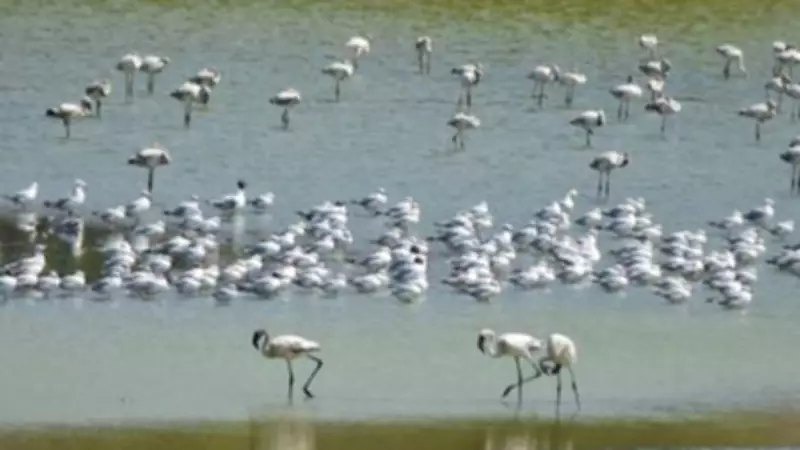
Navi Mumbai's Flamingo Wetlands Face Toxic Crisis, Activists Declare Emergency
Climate activists have sounded a 'wetlet emergency' in Navi Mumbai, as three critical flamingo habitats have turned toxic, with water sample tests revealing alarming results that threaten the entire ecosystem. The deteriorating condition of the DPS, NRI, and T S Chanakya lakes at Nerul—which serve as satellite wetlands for the Thane Creek Flamingo Sanctuary (TCFS), a designated Ramsar site—has sparked urgent calls for government intervention.
Alarming Water Test Results and Flamingo Absence
Water sample tests commissioned by the NatConnect Foundation indicate a system under severe stress, with activists sending messages to Prime Minister Narendra Modi and Maharashtra Chief Minister Devendra Fadnavis to highlight the crisis. The warning is reinforced by the complete absence of flamingos this season, a stark departure from the usual November to May flamingo season, where January to March marks peak viewing time for bird enthusiasts gathering to witness the iconic pink parade.
B N Kumar, director of NatConnect Foundation, stated: "The absence of flamingos this season is a clear indicator that something is critically wrong. These wetlands are not just scenic spots; they are vital habitats."

Key Indicators Reveal Stagnant, Polluted Waters
Four basic water quality indicators—Total Dissolved Solids (TDS), pH, Biochemical Oxygen Demand (BOD), and Chemical Oxygen Demand (COD)—paint a consistent and troubling picture of decline. The results show over-concentrated, stagnant water rather than the natural tidal flushing essential for healthy intertidal wetlands.
Kumar explained: "Put simply, all four indicators tell the same story—the water is not moving as it should in a healthy wetland. Instead of being regularly flushed by tides, these areas are turning into stagnant, polluted basins due to blocked or restricted tidal flow."
Governance Failures and Development Pressures
Activists squarely blame governance failure for the crisis, pointing to unchecked development and regulatory apathy. The City and Industrial Development Corporation (CIDCO) is cited as largely responsible, with climate activist Nandakumar Pawar accusing regulators like the Maharashtra Coastal Zone Management Authority and the forest department of simply looking the other way.
Pawar warned: "These wetlands are a public asset being destroyed in plain sight. CIDCO's actions, prioritizing concrete over conservation, are devastating these ecosystems despite court orders."
Ecosystem Collapse and Public Health Risks
Flamingos depend on algae and microorganisms that thrive in balanced wetland conditions. As water quality deteriorates, the food chain collapses, turning feeding grounds into stressed habitats. While flamingos have adapted to degraded sites in the past, their current absence suggests the system may have crossed a critical threshold, with broader implications for biodiversity and groundwater safety.
Rekha Sankhala of Save Flamingos and Mangroves Forum said: "These wetlands were our pride. Today, they are being destroyed in full view. We urge authorities to treat this as a public health emergency."
Calls for Immediate Action and Accountability
Activists are demanding accountability and urgent government intervention. Sandeep Sareen of the Navi Mumbai Environment Preservation Society (NMEPS) highlighted that lab results expose "toxic waters" driven by unchecked development, warning that flamingos are "the canary in our ecosystem's coal mine."
Activist Pamela Cheema emphasized: "CIDCO's deliberate neglect in a time of climate crisis has put groundwater and biodiversity at risk. We need immediate action to save these wetlands before it's too late."
The situation underscores a broader environmental challenge, where wetland degradation not only threatens iconic species like flamingos but also jeopardizes local ecosystems and public health, calling for swift regulatory and conservation measures.






