NGT Takes Haryana Government to Task Over Gurgaon's Groundwater Crisis
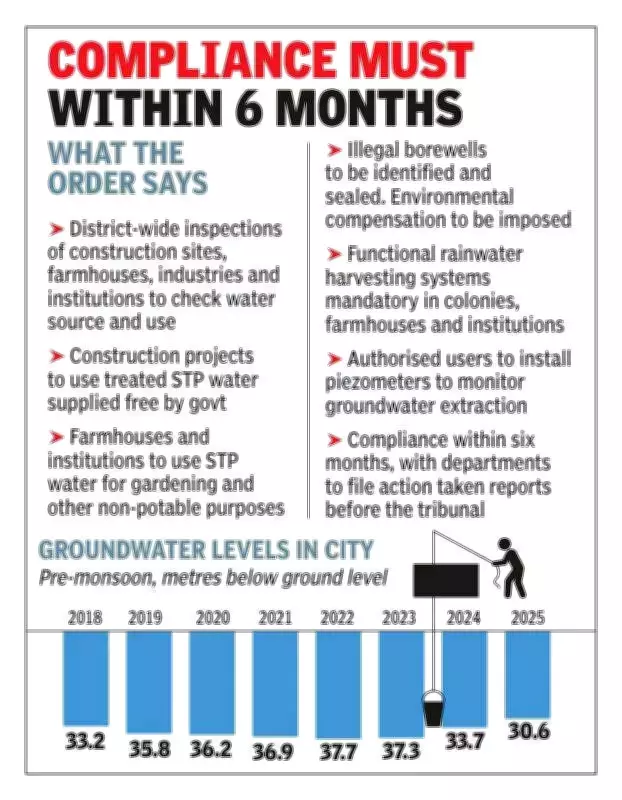
The National Green Tribunal (NGT) has delivered a scathing rebuke to the Haryana government for its failure to curb rampant illegal groundwater extraction in Gurgaon. In a decisive order dated February 10, the tribunal mandated comprehensive inspections across the city and set a strict six-month deadline for corrective action.
Alarming Extraction Figures Prompt Tribunal Action
The tribunal's intervention was triggered by a Times of India report titled "Gurgaon a Groundwater Dark Zone, But Extraction Over 2 Times the Limit," published on August 5, 2025. Official data from the National Compilation on Dynamic Groundwater Resources revealed a dire situation:
- In 2024, Gurgaon extracted 212% of its permissible annual groundwater limit—more than double the sustainable amount.
- The extraction rate stood at 195% in 2025, indicating a persistent crisis.
The NGT's principal bench, comprising Chairperson Prakash Shrivastava and Expert Member Dr. A. Senthil Vel, noted that official responses from various departments were "heavy on plans and claims, but light on enforcement." The order explicitly stated, "None of the above replies reflects the effective action by authorities at the ground level to check the unauthorised withdrawal of groundwater."

Comprehensive Inspection Drive Ordered
The tribunal has directed authorities to launch an immediate, district-wide inspection campaign targeting:
- Construction sites
- Farmhouses
- Industrial units
- Educational institutions
- Pharmaceutical companies
- Public institutions
For each construction site, authorities must ascertain the quantity and source of water used. The NGT has mandated that all project proponents must transition to using sewage treatment plant (STP)-treated water, with the government responsible for supplying this water free of cost to construction projects.
Specific Mandates for Different Sectors
The tribunal issued detailed instructions for various entities:
Farmhouses: Noting that large-scale extraction occurs for gardening and horticulture, the bench ordered that "these farm houses must utilise STP-treated water for such purposes."
Rainwater Harvesting: All residential colonies, farmhouses, and institutional areas must maintain "effectively operating rainwater harvesting systems."
Non-potable Uses: For activities like car washing, vehicle servicing, and dust mitigation where water doesn't come into human contact, "use of STP-treated water instead of extracting groundwater be ensured and encouraged."
Enforcement and Penal Measures
The NGT has empowered the Haryana Water Resources Authority to inspect all construction sites and farmhouses to identify illegally operating borewells. Where illegal borewells are found:
- They must be sealed immediately
- Environmental compensation shall be imposed by the Haryana State Pollution Control Board
Even legal groundwater users will face stricter monitoring. The tribunal has ordered the installation of piezometers at all permitted extraction sites to measure usage accurately and enable appropriate charging.
Strict Timeline and Accountability
The entire compliance exercise must be completed within six months, with each responsible authority required to file a separate action taken report before the tribunal. The bench has kept the option open to re-list the matter if compliance is found inadequate.
Referring to the TOI report, the bench observed that it "clearly mentioned unauthorised and illegal extraction of groundwater by entities like builders, industries, educational institutions, pharmacy firms, residential societies." Authorities are now required to take "effective action at the ground level" against each category of violator.
This comprehensive order represents one of the NGT's most forceful interventions in urban water management, highlighting the critical groundwater crisis in one of India's most rapidly developing urban centers.