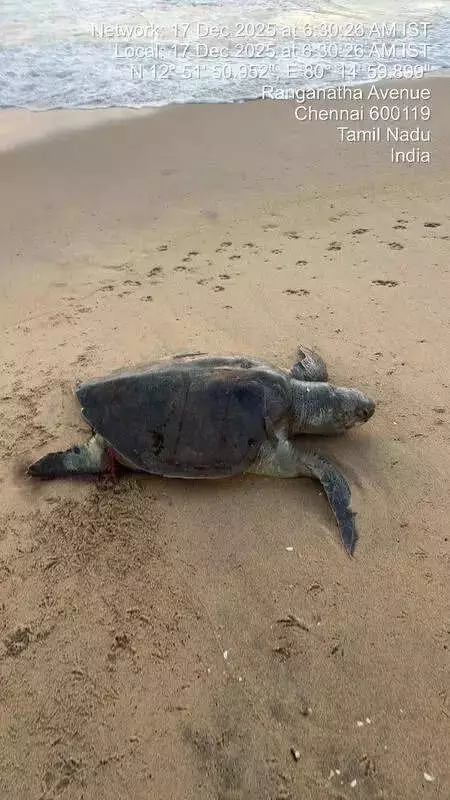
The shores of Chennai and Chengalpet have become the grim final resting place for at least 35 sea turtles in recent weeks, casting a shadow over the annual nesting season. The carcasses, discovered over the last week, have raised serious concerns among conservationists and wildlife authorities, who suspect the actual death toll may be significantly higher.
A Disturbing Pattern During Critical Season
This alarming incident comes just two weeks into the crucial annual mating and nesting period for these endangered marine creatures. Between November 25 and December 16, residents and officials documented at least 20 turtle deaths in Uthandi alone, a certified nesting site. An additional 15 carcasses were found washed up last week along the coastline.
K A Muthukumaran, a resident of Uthandi, confirmed the distressing numbers. While the visible count stands at 35, environmental groups fear many more deaths may have gone unreported, lost to the sea.

Mystery and Suspected Causes
Forest department officials have stated that the immediate cause of death is not visually apparent this time, unlike in previous incidents. "These carcasses showed no visible injury," a forest ranger noted, emphasizing the need for postmortem examination to ascertain the exact cause. However, preliminary observations point towards a persistent and deadly threat: entanglement in fishing nets.
A forest ranger indicated that nets laid to catch squid are a primary suspect, often trapping and drowning the air-breathing turtles. This theory is bolstered by environmental activists who highlight rampant violations of fishing zone regulations.
K Shravan from the Students Sea Turtle Conservation Network stressed that these are not isolated events. "These deaths occur every year," he said, urging authorities to proactively supply and enforce the use of Turtle Excluder Devices (TEDs) among fishing communities.
Accountability and a Call for Action
Chennai Wildlife Warden Manish Meena informed that samples have been collected from the carcasses and an additional veterinarian has been appointed to assist. Corrective steps will be formulated only after the postmortem reports are available. He compared the situation to the previous year, stating, "Deaths have been minimal this year compared to 2024, but we will take steps to minimise this."
The issue of accountability is complex. Environmentalists report that trawling boats frequently operate illegally within five nautical miles of the shoreline, a zone meant to be protected. However, K Saravanan of the Coastal Resources Centre provided a crucial perspective, explaining that ocean currents complicate blame. "When the flow is from north to south, a turtle that dies due to fishing in Puducherry or Andhra Pradesh can wash up in Chennai or Chengalpet shores," he said, implying that fishermen from one district cannot be solely held responsible.
This tragic event underscores an urgent need for coordinated regional action, stricter enforcement of maritime laws, and the widespread adoption of turtle-friendly fishing equipment to protect these vulnerable species during their most critical life cycle phase.