

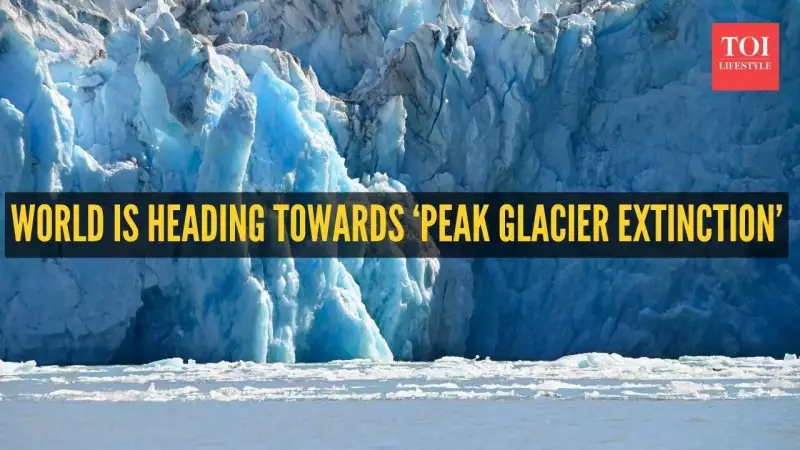
The world's glaciers are approaching a catastrophic tipping point, entering an era of peak extinction where the rate of their complete disappearance will hit unprecedented levels. According to groundbreaking research published in the journal Nature Climate Change, the planet could witness between 2,000 and 4,000 glaciers vanishing every single year by the middle of this century. The exact pace of this loss hinges directly on future greenhouse gas emissions, marking a crisis of a scale never before recorded in modern history.
From Abstract Threat to Visible Reality
For glaciologists, this looming peak is no longer a distant, abstract projection. It is a stark reality already visible in mountain ranges worldwide, where glaciers that once defined majestic landscapes have now disappeared entirely. The phenomenon of complete glacier extinction is accelerating, transforming scientific forecasts into tangible loss.
One of the most poignant examples occurred in 2019 in Switzerland, where hundreds gathered for a symbolic funeral for the Pizol glacier. Estimated to be around 700 years old, it had been reduced by human-driven climate change to mere scattered chunks of ice. Mourners dressed in black laid flowers, and a priest spoke, marking a solemn milestone. Pizol was not an isolated case but a harbinger of a global pattern that is now unfolding at an alarming speed.

Thousands of glaciers have already been lost over recent decades, and this new research indicates the rate of these complete losses is set to skyrocket in the coming years.
Why Tracking Complete Glacier Extinction Matters
Traditionally, glacier research has concentrated on measuring the volume of ice melt. However, less attention has been paid to counting how many individual glaciers vanish completely. This metric is challenging because definitions vary, and smaller glaciers can be hard to detect. Scientists estimate there are over 200,000 glaciers globally.
The authors of the new study argue that tracking total glacier loss is crucial for grasping the full impact of climate change. "It shows climate change does not just lead to some ice melt, but it leads to the complete extinction of many glaciers," explained Matthias Huss, a study author and glaciologist at ETH Zürich, who attended Pizol's funeral.
Using a global glacier database, the team modeled the future of individual glaciers under various warming scenarios. They defined extinction as the point when a glacier becomes too small to qualify—either when its area shrinks below 0.01 square kilometers or its volume falls to less than 1% of its size around the year 2000. Their goal was to identify the period of peak glacier extinction, when the annual disappearance rate is highest.
Timeline and Severity: A Direct Link to Warming
The timing and intensity of this peak depend almost entirely on how much the planet warms. The study outlines a clear and concerning timeline based on different emission futures.
If global warming is miraculously limited to 1.5 degrees Celsius above pre-industrial levels—a target the world is currently missing—glacier extinction would peak around 2041, with roughly 2,000 glaciers lost per year.
Under current, insufficient climate pledges, which put the world on a path to about 2.7 degrees of warming, the extinction would unfold over a longer period. Approximately 3,000 glaciers would disappear each year between 2040 and 2060.
In a worst-case scenario of 4 degrees of warming, the peak shifts to the mid-2050s, with annual losses soaring to around 4,000 glaciers per year. This rate is three to five times higher than what the globe experiences today.
The impact will not be uniform. Regions dominated by smaller glaciers, like the European Alps, parts of the Andes, and North Asia, will be hit hardest and fastest. More than half of their glaciers could vanish within the next two decades, with peak extinction arriving around 2040. Areas with larger ice masses, such as Greenland and the Russian Arctic, will reach their peak later this century.
The Stark Legacy by 2100
The long-term survival of the world's glaciers hangs in the balance of today's emissions decisions. The study projects a grim future if action is not taken.

At 2.7 degrees of warming, only about 20% of today's glaciers are expected to remain by 2100. Limiting warming to 1.5 degrees could preserve roughly half. In a 4-degree world, scientists project near-total glacier loss.
"This study does a great job at highlighting the fact not only are glaciers melting worldwide, many of them may be entirely gone in the coming decades; and the trend is accelerating," said Eric Rignot, professor of Earth system science at the University of California, Irvine, who was not involved in the research. He emphasized this is a point of no return, as reforming a glacier would take centuries.
Beyond being critical water sources, glaciers underpin tourism, local economies, and the cultural identity of mountain communities. "They are really icons of climate change," noted study author Harry Zekollari, a glaciologist at Vrije Universiteit Brussel. "If you go to someone, you talk to them on the street about the fact that temperatures have risen by 2 degrees, it's really difficult to picture, but glaciers, they're so visual." Their disappearance will be the most visible and irrevocable testament to a warming world.





