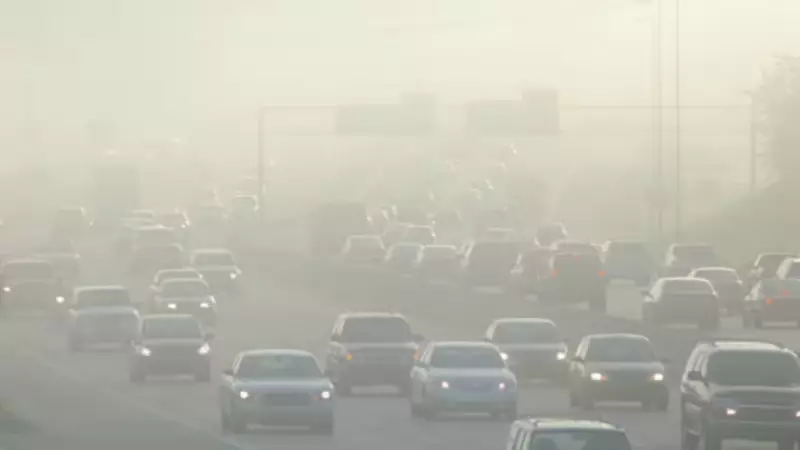
For decades, the dense winter fog that blankets northern India has been a major disruptor, crippling air and rail travel and slowing daily life across the vast Indo-Gangetic plain to a standstill. Groundbreaking new research now provides a critical insight: the severe air pollution plaguing the region is not merely a co-occurring problem but is actively intensifying these fog events, making them worse and more persistent.
The Pollution-Fog Link: A Clear Mechanism Uncovered
A peer-reviewed study led by scientists from the Indian Institute of Technology (IIT) Madras, published in the prestigious journal Science Advances, has identified the precise physical process behind this alarming phenomenon. The research, which analyzed 15 years of satellite data and ran high-resolution weather-chemistry simulations, establishes a direct cause-and-effect relationship.
The culprit is the high concentration of aerosols—tiny particles released from vehicle exhaust, industrial emissions, biomass burning, and other human activities. The study found that these pollutants are "invigorating" the fog layers over parts of northern India. During polluted conditions, the fog over the Indo-Gangetic plain became approximately 15-20% thicker, often extending to heights of 400-600 meters.

"Crucially, this thickening happens mainly at the top of the fog layer, not at the surface," the research highlights. This counterintuitive finding is key to understanding the mechanism. More aerosols lead to a greater number of fog droplets. This process enhances cooling at the fog's top, which in turn increases vertical mixing in the atmosphere, ultimately pumping more moisture upward and building a denser, taller fog blanket.
Surprising Discovery: Larger Droplets in Polluted Fog
One of the study's most intriguing revelations came from satellite observations. It showed that fog forming under polluted conditions contains larger water droplets near its top. This defies the usual behavior seen in clouds, where pollution typically leads to a larger number of smaller droplets.
The researchers explain that in a foggy environment, where moisture is already abundant and the atmosphere is nearly saturated, the unique dynamics take over. The enhanced condensation and cooling at the fog top, driven by aerosols, actually allow the droplets to coalesce and grow larger despite the high concentration of pollutant particles. This finding underscores the complex and specific ways in which pollution interacts with winter weather in North India.
Implications for Public Health and Policy
The implications of this research are profound and extend beyond mere visibility issues. Thicker, longer-lasting fog exacerbates transportation chaos, increasing economic costs and safety risks. It also traps pollutants closer to the ground for extended periods, potentially worsening public health crises related to air quality.
The study delivers a powerful, dual-purpose message for policymakers. Controlling aerosol emissions is not only essential for achieving cleaner air but may now also be a critical strategy for mitigating the intensity and duration of debilitating winter fog. Tackling the sources of pollution—from vehicular and industrial emissions to agricultural burning—could yield a double benefit: clearer skies and more manageable winter weather.
As northern India braces for its next fog season, this research from IIT Madras provides a scientific imperative to accelerate air pollution control measures, framing them as a necessary step to untangle both a public health and a persistent climatic nuisance.