Kerala's Poonthura Geotube Breakwater Project Becomes Operational After Years of Delay
After enduring years of delays, fishermen along the Poonthura coast in Thiruvananthapuram are finally witnessing significant progress as the long-pending offshore geotube breakwater project has become operational. This coastal protection initiative, designed to mitigate severe sea erosion, achieved a crucial milestone with the completion of geotube installation last month.
Key Milestones and Upcoming Inspections
A team from the National Institute of Ocean Technology (NIOT) is set to inspect the site on April 25, with a final report expected by May 15. However, officials emphasize that the system's true performance can only be assessed during the southwest monsoon, when wave intensity reaches its peak. This period will serve as the first real test for the fully installed structure.
Project Details and Implementation
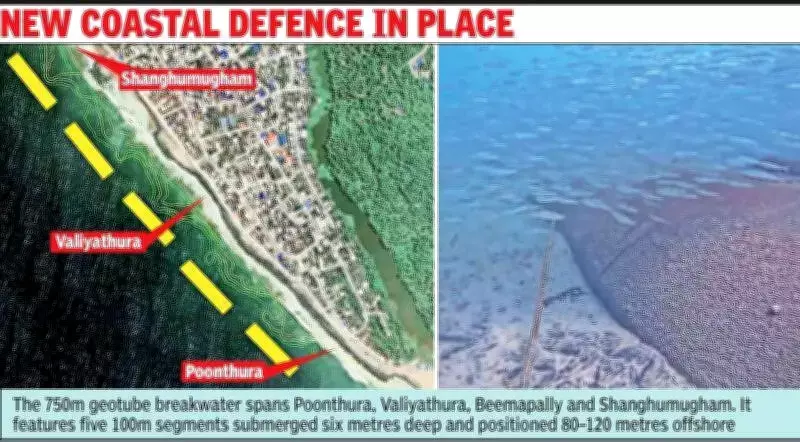
Implemented by the Kerala State Coastal Area Development Corporation (KSCADC) with technical support from NIOT and funding from the Kerala Infrastructure Investment Fund Board, the Rs 20 crore project aims to protect vulnerable stretches of the capital's coastline from persistent wave action. Launched in 2021 as a pilot, the project spans approximately 750 metres, covering areas including Poonthura, Valiyathura, Beemapally, and Shankhumukham.

The project features five offshore breakwater segments, each 100 metres long, positioned parallel to the shore at a distance of 80 to 120 metres and at a depth of around six metres. These structures consist of large sand-filled geotubes arranged in three layers, engineered to dissipate wave energy and encourage natural sand accumulation, thereby helping to stabilise the shoreline.
Sustainable Approach and Community Response
KSCADC officials describe the project as a shift towards sustainable coastal protection. "The system works with natural processes rather than resisting them. Initial observations are encouraging," an official stated, while acknowledging that the upcoming monsoon will be critical for evaluation. Fishermen, initially sceptical due to repeated delays, have responded with cautious optimism. Many reported being consulted in later stages and expressed hope that the system will safeguard their homes, livelihoods, and coastal infrastructure.
This development marks a significant step in addressing coastal erosion challenges in Kerala, with potential implications for similar projects in other regions facing similar environmental threats.