

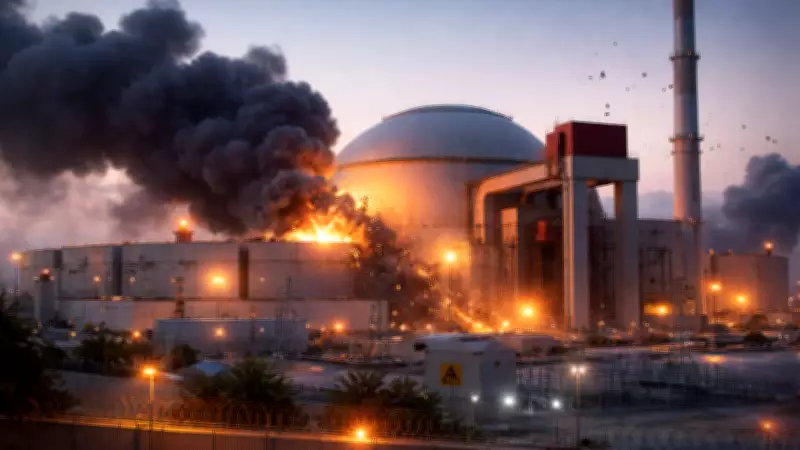
IAEA Confirms Projectile Impact Near Iran's Bushehr Nuclear Facility
The International Atomic Energy Agency (IAEA) issued a critical statement on Thursday, confirming that a projectile strike occurred in close proximity to Iran's Bushehr Nuclear Power Plant. The incident, which targeted a structure approximately 350 meters from the reactor core, has ignited significant international concern regarding nuclear safety protocols during armed conflicts.
No Reactor Damage Reported, But Safety Principles Violated
In an official communication posted on social media platform X, IAEA Director General Rafael Mariano Grossi provided crucial details about the event. While confirming that the reactor itself sustained no damage and no personnel injuries were reported, Grossi delivered a stern warning about the implications of such attacks.
"Although there was no damage to the reactor itself nor injuries to staff, any attack at or near nuclear power plants violates the seven indispensable pillars related to ensuring nuclear safety and security during an armed conflict and should never take place," Grossi emphasized in his statement.

Location and Operational Details of the Affected Facility
The Bushehr Nuclear Power Plant, situated along Iran's Persian Gulf coastline approximately 480 miles south of Tehran, represents a significant energy infrastructure project for the nation. The facility currently operates one functional unit, with two additional Russian-designed units actively under construction, expanding Iran's nuclear energy capacity.
The IAEA has not disclosed specific details regarding the nature of the projectile that struck near the plant. However, both Iranian and Russian authorities have acknowledged the incident, with Russia's state nuclear corporation Rosatom providing additional context about the timing and location of the impact.
Russian Nuclear Corporation Provides Detailed Account
Alexei Likhachev, head of Rosatom, revealed that the strike occurred precisely at 15:11 GMT on Tuesday, impacting an area adjacent to the plant's meteorological service facility, which is located near an operational power unit. Likhachev stressed that safety remains the absolute priority for all personnel involved in the project.
"The safety of human life is our absolute priority. We had previously partially reduced the number of personnel at the construction site of Bushehr Nuclear Power Plant Units 2 and 3. About 250 employees and their families were safely evacuated from Iran," Likhachev explained.
He further noted that children of employees had been preemptively evacuated before the armed conflict escalated, with approximately 480 personnel remaining on site and preparations underway for a potential third evacuation phase.
Escalating Regional Tensions and Nuclear Safety Concerns
This incident unfolds against a backdrop of intensifying hostilities in the region, following coordinated attacks by the United States and Israel on Iranian leadership and military infrastructure on February 28. Iran has subsequently launched retaliatory measures, creating a volatile security environment that now threatens critical nuclear facilities.
Grossi has repeatedly advocated for diplomatic solutions to these escalating tensions, stating that "to achieve the long-term assurance that Iran will not acquire nuclear weapons and for maintaining the continued effectiveness of the global non-proliferation regime, we must return to diplomacy and negotiations."
Historical Context and Future Implications
The Bushehr plant's first unit was successfully connected to Iran's electrical grid in 2011, featuring a Russian-designed VVER reactor with a capacity of 915 MWe. Construction continues on two additional VVER-1000 units, with Unit 2 making steady progress since its initial concrete pouring in 2019 and Unit 3 currently under development.
Iranian authorities have projected that Unit 2 could become operational by 2029, while Rosatom and the Atomic Energy Organisation of Iran signed a cooperation agreement in September 2025 focused on small modular reactors. This aligns with Iran's ambitious goal to expand its nuclear capacity to 20 GW by 2041.

Previous Conflicts and Current Vulnerabilities
Interestingly, the Bushehr facility remained untouched during the 12-day Israel-Iran conflict in June, when the United States targeted three Iranian nuclear enrichment sites instead. Those attacks damaged centrifuges and likely buried Tehran's stockpile of highly enriched 60% uranium underground, leading Iran to restrict IAEA access to those locations.
The current incident raises renewed concerns about the vulnerability of operational nuclear power plants during military conflicts, a worry that has intensified globally since Russia's full-scale invasion of Ukraine in 2022, where nuclear facilities have repeatedly faced threats.
Environmental and Regional Security Ramifications
Any successful strike on an operational nuclear power plant carries the catastrophic risk of radioactive material leakage into the surrounding environment. This concern becomes particularly acute for Gulf Arab nations that depend heavily on desalination plants in the Persian Gulf region for their freshwater supply.
A potential radiation leak into these waters would create an existential crisis for multiple nations, highlighting the interconnected nature of regional security and environmental safety. Rosatom has joined the IAEA in condemning the recent incident, urging all parties to de-escalate tensions around nuclear facilities to prevent potentially disastrous consequences.





