

Punjab Faces Uphill Battle in Legacy Waste Remediation
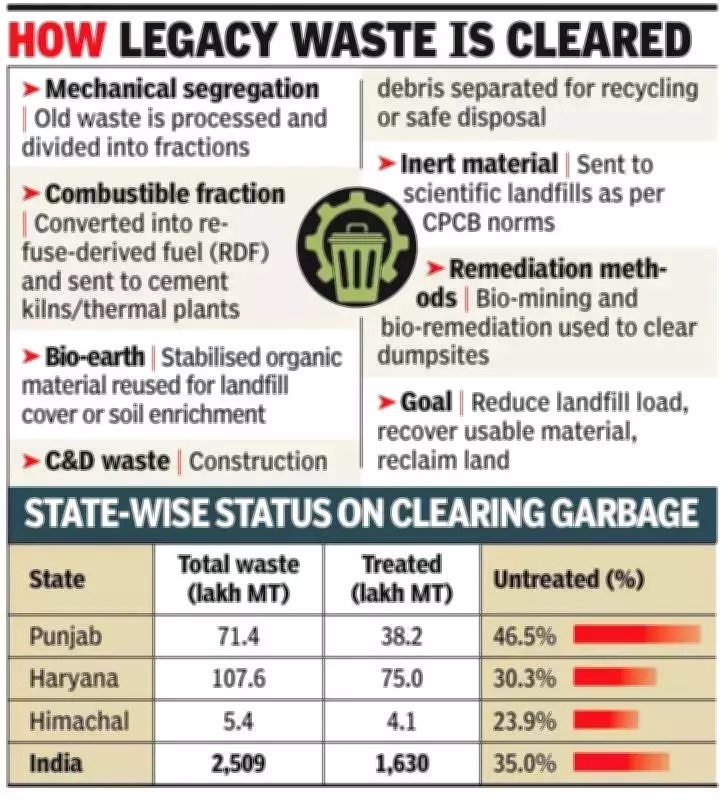
Despite ongoing cleanup initiatives, Punjab continues to grapple with a significant backlog of legacy waste, with 46.5% of its accumulated garbage remaining untreated. This highlights the immense environmental and logistical challenges confronting the state's urban centers as they strive to address years of neglect in waste management.
Comparative Performance with Neighboring States
Punjab's progress lags behind its neighboring states, according to recent data. Haryana has managed to treat 69.7% of its legacy waste, leaving 30.3% untreated, while Himachal Pradesh has processed 76.1%, with only 23.9% still pending. This disparity underscores varying levels of efficiency and resource allocation in waste remediation efforts across the region.
National Overview of Waste Management
A reply tabled in the Rajya Sabha reveals that nationwide, 2,474 dumpsites containing approximately 25.1 crore metric tons of legacy waste have been identified. Of these, 1,159 sites have been fully cleared, and remediation work is actively underway at 985 locations. Overall, 16.3 crore metric tons, or 65% of the total waste, has been successfully processed to date.

State-Specific Waste Statistics
Breaking down the numbers, Punjab accounts for 71.4 lakh metric tons of legacy waste, of which 38.2 lakh metric tons have been treated. In contrast, Haryana has cleared 75.0 lakh metric tons out of 107.6 lakh metric tons, and Himachal Pradesh has processed 4.1 lakh metric tons out of 5.4 lakh metric tons. These figures illustrate the scale of waste accumulation and the progress made in each state.
Processing Methods and Government Initiatives
The government employs mechanical separation techniques to process legacy waste, dividing it into fractions such as combustible material, refuse-derived fuel, bio-earth, and construction waste. Combustible materials are directed to cement kilns or thermal plants for energy recovery, while the remaining fractions are disposed of in accordance with Central Pollution Control Board norms to minimize environmental impact.
To accelerate remediation efforts, the Centre has launched the Dumpsite Remediation Acceleration Programme (DRAP), targeting 214 dumpsites across 200 urban local bodies for clearance by September 2026. Since November 2025, this program has processed 528.2 lakh metric tons of waste, demonstrating a concerted push towards cleaner urban environments.
DRAP Implementation in Northern States
Under DRAP, Punjab has five dumpsites identified for remediation, with a total of 44.8 lakh metric tons of waste. Since November 2025, 13.1 lakh metric tons have been cleared, leaving 31.8 lakh metric tons pending. Haryana is addressing nine sites under the program, while Himachal Pradesh has one site involved, reflecting targeted efforts based on regional needs.
Future Regulatory Framework
The ministry has announced that urban local bodies will adhere to the Solid Waste Management Rules, 2026, effective from April 1. This regulatory update aims to standardize and improve waste management practices across the country, ensuring more sustainable and efficient handling of both legacy and current waste streams.
The persistent issue of untreated legacy waste in Punjab, despite advancements in neighboring states and national programs, calls for enhanced strategies and resources to meet environmental goals and protect public health.






