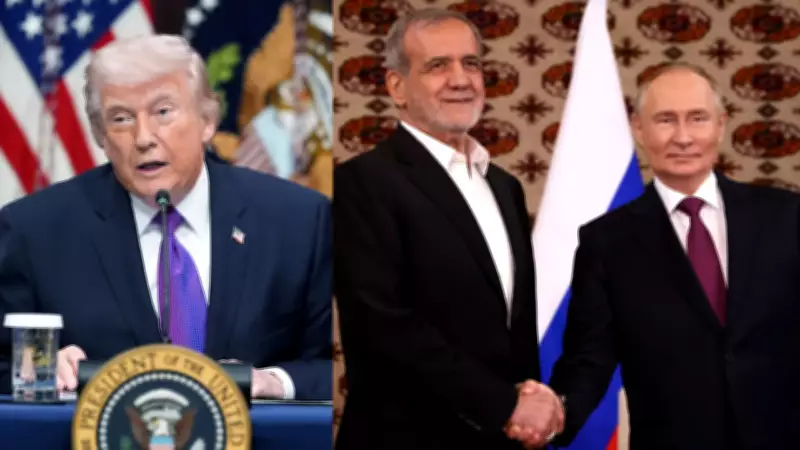
Russia Reportedly Aids Iran with Real-Time US Military Intelligence in Escalating Conflict
According to a recent report citing officials familiar with the intelligence, Russia has been providing Iran with real-time information on the locations of American military assets in the Middle East. This includes detailed data on US warships, aircraft, and other critical military installations, potentially enabling Tehran to more accurately target US forces during the ongoing regional conflict.
Intelligence Sharing Details and Anonymous Sources
The Washington Post reported that three officials, who spoke on condition of anonymity due to the sensitivity of the matter, confirmed Moscow has been sharing this targeting information since the war began on Saturday. This assistance marks the first reported indication that another major US adversary may be indirectly involved in the rapidly escalating conflict across the region.
"It does seem like it’s a pretty comprehensive effort," one of the officials told the newspaper, though they noted the full extent of Russia's targeting support remains unclear. Officials highlighted that Iran's own ability to track US forces had been degraded in the early days of the war, making Russian intelligence particularly valuable.

Impact on Iranian Strikes and Targeting Precision
Analysts suggest this reported intelligence sharing could help explain the precision of some Iranian strikes on US-linked targets. Since the conflict erupted, Iran has launched thousands of one-way attack drones and hundreds of missiles toward US military positions, embassies, and other regional targets.
One particularly deadly attack on Sunday killed six US troops in Kuwait and injured several others when an Iranian drone struck a military facility. Dara Massicot, a Russia military expert at the Carnegie Endowment for International Peace, noted that some of Iran's strikes have targeted critical infrastructure with remarkable accuracy.
"Iran is making very precise hits on early warning radars or over-the-horizon radars," she said. "They’re doing this in a very targeted way. They’re going after command and control." The CIA station at the US embassy in Riyadh, Saudi Arabia's capital, was also struck in recent days.
Russian Satellite Capabilities and Enhanced Targeting
Experts emphasize that Russia's advanced satellite capabilities could significantly improve Iran's targeting ability. Iran possesses only a limited number of military-grade satellites and lacks its own satellite constellation, making imagery and data from Russia especially valuable. Moscow has further refined its intelligence and targeting capabilities during the ongoing war in Ukraine.
Nicole Grajewski of the Harvard Kennedy School's Belfer Center, who studies Russia-Iran cooperation, observed that the quality of Iran's retaliatory strikes appears to have improved substantially. "They’re getting through air defenses," she said, adding that the strikes demonstrate a high degree of "sophistication" in target selection and the ability to overwhelm some US and allied defense systems.
Washington's Response and China's Role
The CIA and the Pentagon declined to comment on the report. A White House spokeswoman, Anna Kelly, did not directly address the alleged Russian assistance but stated the US campaign was weakening Iran's military capabilities. "The Iranian regime is being absolutely crushed," she said. "Their ballistic missile retaliation is decreasing every day, their navy is being wiped out, their production capacity is being demolished, and proxies are hardly putting up a fight."
US Defense Secretary Pete Hegseth said earlier this week that Russia and China were "not really a factor here" when questioned about their possible involvement. Two officials cited in the report indicated that China does not appear to be assisting Iran's military response, despite the close ties between the two countries.
Wider Geopolitical Context and Strategic Considerations
Russia has publicly called for an end to the conflict, describing it as an "unprovoked act of armed aggression." The Russian embassy in Washington did not respond to a request for comment from The Washington Post.

This reported intelligence sharing reflects the evolving dynamics among US adversaries. During the Ukraine war, Iran, China, and North Korea have provided various forms of military or material support to Russia, while the United States has supplied Ukraine with weapons and intelligence to improve targeting of Russian forces.
Iran has been a key partner for Moscow in that conflict, providing technology for low-cost one-way attack drones that Russia has used extensively against Ukrainian cities and infrastructure. "The Russians are more than aware of the assistance that we’re giving the Ukrainians," one official told the newspaper. "I think they were very happy to try to get some payback."
Despite the reported intelligence support, analysts believe Moscow is unlikely to directly enter the conflict as it remains heavily focused on the war in Ukraine. "The Kremlin is very much considering this is not their problem and not their war," Massicot said, adding that from a strategic standpoint "Ukraine is still far and away the number one priority."