

Sahara's Green Past Revealed: Desert Formed in Centuries, Not Millennia
Approximately 8,000 years ago, the Sahara Desert was not the vast, barren expanse of sand we recognize today. Instead, it was a verdant, rain-soaked region crisscrossed with numerous lakes and flowing rivers. This lush environment supported a diverse array of wildlife, including hippos and elephants, and fostered thriving human communities in what would later become one of Earth's most extreme and inhospitable deserts.
Unlocking the Secrets of the Green Sahara
For many decades, scientists have pieced together evidence of this "Green Sahara" from fossilized bones, ancient pollen samples, and prehistoric rock art. However, researchers faced significant challenges in determining the precise timeline of this humid era—specifically when it began, how long it persisted, and the rate at which it ultimately vanished.
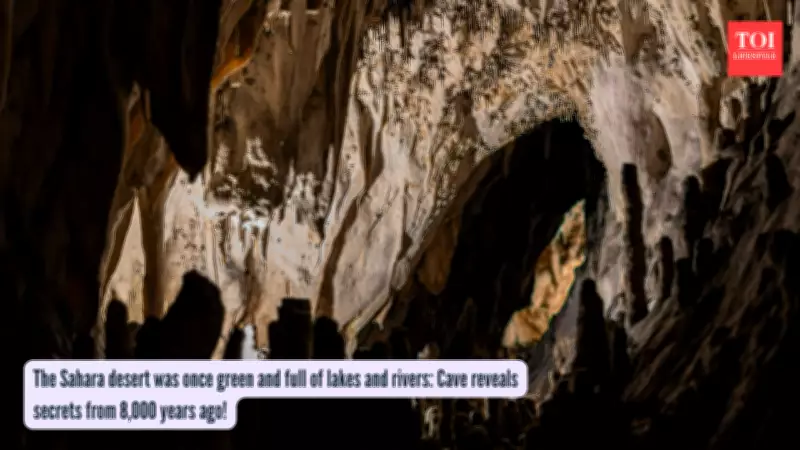
A groundbreaking discovery within a remote Saharan cave has now provided unprecedented clarity. By analyzing mineral deposits that accumulated over thousands of years inside this desert cave, a team led by Samuel Hollowood from the University of Oxford has mapped the most recent humid period of the Sahara with remarkable accuracy.

According to the new study, published in the esteemed journal Earth and Planetary Science Letters, the African Humid Period did not gradually decline over millennia. Instead, it abruptly shifted into a desert landscape within a mere few centuries.
What Cave Minerals Reveal About Sahara's Climate History
Scientists have long understood that the Sahara has oscillated between green and dry phases multiple times over the past several million years. Yet, the timing of the most recent "greening" event remained ambiguous and poorly defined.
The research indicates that these humid phases align with 21,000-year cycles in Earth's orbit, known as "precession." These orbital shifts increase summer sunlight in the Northern Hemisphere, thereby intensifying the West African monsoon and bringing substantial rainfall to the region.
The recent cave study, spearheaded by Samuel Hollowood of Oxford's Department of Earth Sciences, focuses on delicate layers of calcite, commonly referred to as "speleothems." These formations are created by dripping water within isolated Saharan caves.
"Speleothems serve as historical records of past temperature and precipitation patterns," explains a summary associated with the Max Planck Institute. These mineral deposits only develop when sufficient rainwater permeates the rock above. Consequently, gaps in the layers signify periods of drought, while continuous bands indicate wetter, more humid conditions.
By meticulously measuring trace elements and stable isotopes trapped within each calcite layer, the research team reconstructed historical rainfall levels and the speed at which the environment dried out. The data precisely narrows the African Humid Period to a specific timeframe, confirming that the Sahara remained consistently green and rainy for thousands of years before experiencing a sudden and dramatic climate collapse.
How Rapidly Did the Sahara Transform Into a Desert?
A central question in the field of paleoclimatology has been whether the Green Sahara faded slowly over thousands of years or underwent a swift "tipping point" collapse. The cave record now strongly supports the latter scenario.
The study reveals that the geochemical transition from wet to arid conditions occurred in approximately 200 to 300 years. In geological terms, this is less than a tenth of a millennium—equivalent to only about seven or eight human generations.
This rapid desertification would have been catastrophic for both human populations and wildlife. As the monsoon retreated southward in irregular pulses, lakes and rivers in the central Sahara diminished or disappeared entirely. Communities that had relied on this intricate inland water network were forced to migrate.
The Smithsonian Institution notes that the transition period between 8,000 and 4,500 years ago left behind rock art depicting giraffes and aquatic scenes, followed by a silence of abandoned settlements as populations congregated toward the Nile River and the desert's peripheries.






