

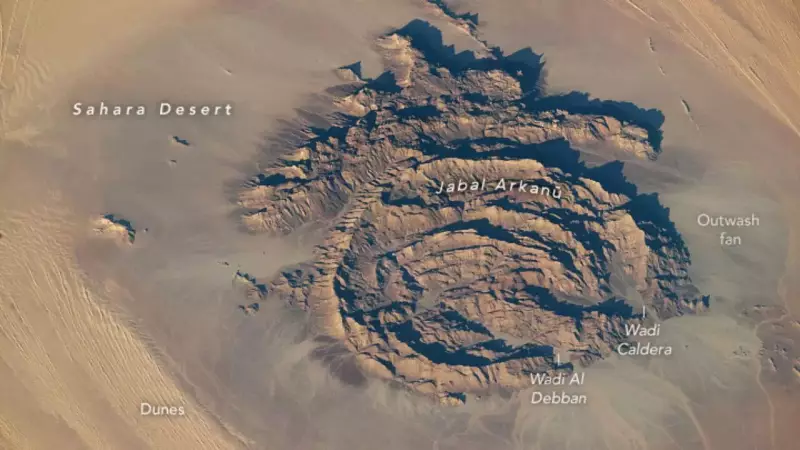
In the vast, sun-scorched expanse of southeastern Libya, the Sahara Desert conceals one of its most perplexing and visually arresting secrets: the near-perfect concentric rings of Jabal Arkanū. Rising abruptly from the flat plains, these massive circular ridges have captivated explorers and baffled scientists for decades, often sparking theories of extraterrestrial origins. However, cutting-edge geological research has now unraveled the true, terrestrial story behind this natural marvel, a story written over millions of years by the Earth's own fiery heart and relentless winds.
From Space: Capturing the Desert's Perfect Geometry
The stunning clarity of Jabal Arkanū's rings was brought into global focus on September 13, 2025. On that day, an astronaut aboard the International Space Station aimed a Nikon Z9 digital camera towards the Libyan desert and captured the formation's breathtaking symmetry. This remarkable photograph was later processed and published by the NASA Earth Observatory, after being enhanced for contrast and cropped to remove lens artefacts.
From an orbital perspective, the geometric precision of the rings becomes undeniable. The image reveals not just the concentric ridges but also outwash fans and a faint network of wadis (dry riverbeds) cutting across the massif, hinting at rare episodes of water flow in one of the planet's most arid regions. This astronaut-captured view is complemented by long-term data from satellites like NASA's Terra mission and JAXA's Tropical Rainfall Measuring Mission, providing scientists with a powerful, multi-scale tool for analysis.

The Geological Truth: Magma, Not Meteorites
For years, the near-perfect circularity of Jabal Arkanū led to speculation that it was the scar of an ancient meteorite impact. Modern science tells a different, more complex tale. Geological evidence confirms the structure is entirely Earth-made, born from repeated magmatic intrusions over immense timescales.
Here is how this natural wonder was formed:
- Magma Intrusion: Molten rock from deep within the Earth repeatedly pushed into existing layers of sandstone, limestone, and quartz.
- Cooling and Uplift: This magma cooled to form igneous rocks like granite and basalt, causing differential uplift and creating a resilient, concentric pattern.
- Millennia of Erosion: Over millions of years, slow erosional forces—primarily wind and extremely rare rainfall—sculpted the landscape. They wore away the softer sedimentary rock, leaving behind the harder, raised rings and scattering boulders and sand in fan-like patterns around the base.
The presence of the two crossing wadis is crucial. It shows that even in an environment with just a few millimetres of annual rainfall, episodic water flow has played a role in the final shaping of this ancient structure.
Why Jabal Arkanū Stands Apart in the Sahara
While other ring complexes like Jabal Al Anaynat exist in the Sahara, Jabal Arkanū is exceptional. Its scale, precise concentricity, and complex geological composition make it a unique case study. The overlapping history of multiple igneous intrusions interacting with specific sedimentary layers has resulted in a formation of unusual clarity and stability.
This makes it an exemplary model for geologists studying how such structures evolve and persist in hyper-arid environments. Comparative studies with nearby formations highlight subtle differences, underscoring the need to combine remote sensing, satellite data, and fieldwork to accurately distinguish between impact craters and endogenous structures like Jabal Arkanū.
A Time Capsule for Understanding Earth's History
The significance of Jabal Arkanū extends far beyond its visual appeal. It serves as a tangible record of planetary processes, offering profound insights into:

- The mechanics of how magma emplaces itself within the Earth's crust.
- How crustal stress distributes over geological time.
- The long-term erosional dynamics that dominate hyper-arid climates.
By studying this formation, scientists can reconstruct the sequence of events that create stable, long-lasting features even under extreme environmental stress. This research enriches our broader understanding of desert landscape evolution, intraplate geological activity, and how igneous and sedimentary systems interact with minimal water influence. Ultimately, Jabal Arkanū provides an invaluable window into the Sahara's deep past and acts as a model for interpreting similar geological features on Earth and beyond.





