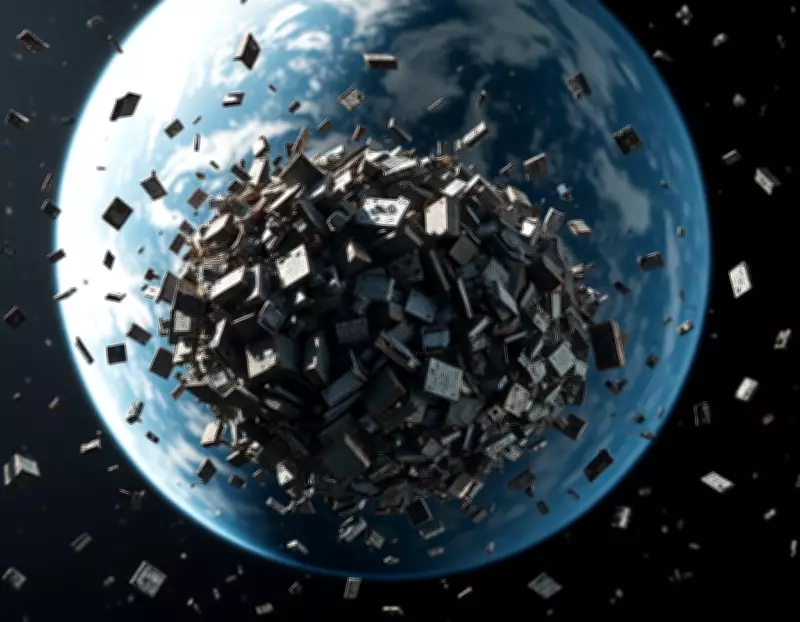
The New Space Race Is Building a Satellite Crematorium Above Earth
A dramatic new phase of the space race is unfolding far above our planet, but its potentially hazardous consequences may not remain confined to the orbital realm. Satellite launches have experienced a sharp and sustained increase in recent years, predominantly driven by commercial mega-constellations engineered to deliver global broadband internet and various other data services. Currently, Earth is encircled by nearly 15,000 active satellites, a significant portion of which are designed with limited operational lifespans of just a few years before requiring replacement.
Deliberate De-Orbiting and Atmospheric Pollution
When these satellites malfunction or reach the conclusion of their service life, operators typically guide them back into the upper atmosphere where they incinerate upon re-entry. This standard practice, known as demisability in engineering terms, aims to mitigate the accumulation of dangerous space debris in low Earth orbit. However, researchers are now initiating critical investigations into the environmental impact of these repeated, controlled burn-ups on delicate atmospheric chemistry, ozone layer stability, and long-term climate processes that remain incompletely understood and mapped by science.
According to a significant study published in The Conversation, the majority of retired satellites are intentionally de-orbited to ensure their disintegration during atmospheric re-entry. The foundational principle is straightforward: the hardware should not survive the fiery descent. Yet, when the scale involves thousands of objects burning up annually, the process ceases to appear negligible. Scientists conducting research on upper atmospheric aerosols during 2023 detected the presence of metal particles directly linked to disintegrating spacecraft. Aluminium, a material extensively used in satellite frames, forms alumina particles upon combustion. These minute particles can remain suspended for extended periods at extremely high altitudes, introducing foreign elements into a sensitive environment.

The Challenge of Scale and Material Uncertainty
The precise material composition inside commercial satellites is rarely disclosed publicly, creating substantial difficulties for accurate scientific modelling. Researchers are consequently forced to work with estimates, and this inherent uncertainty itself constitutes a major part of the growing concern within the scientific community.
Plans for One Million Satellites Would Radically Alter the Scale
In early 2025, SpaceX submitted a formal application to the Federal Communications Commission seeking approval for a dramatic expansion of its Starlink network. The ambitious proposal outlines plans for deploying up to one million additional satellites, described in regulatory filings as essential infrastructure for supporting future artificial intelligence data systems. Current Starlink V2 mini satellites weigh approximately 800 kilograms, with later versions anticipated to be even heavier. The proposed V3 models are expected to be substantially larger, approaching the mass and structural size of a small aircraft.
Every single one of these satellites would eventually undergo re-entry. Utilizing assumptions aligned with earlier atmospheric studies, researchers have projected that one million satellites could release close to a teragram of alumina particles into the upper atmosphere over their operational lifetimes. This staggering figure exists alongside emissions from rocket launches themselves, which are already documented contributors to upper atmospheric heating and ozone layer depletion.
The chemistry at these extreme altitudes is exceptionally complex. The introduction of small particles can fundamentally alter how heat is absorbed and how ozone molecules react. Scientific models attempting to predict these outcomes are continually being refined as new data emerges.

Collision Risks in Orbit Are Already Escalating
The environmental pressure is not solely atmospheric. In the congested domain of low Earth orbit, collision avoidance manoeuvres are becoming a routine operational necessity. The Outer Space Institute maintains an analytical model known as the CRASH Clock, which estimates that if all active avoidance measures were to cease, a significant collision could occur within mere days.
Experts have long issued warnings about the Kessler syndrome, a catastrophic cascading effect where debris generated from a single collision triggers a chain reaction of subsequent impacts. A higher population of satellites directly increases the statistical likelihood of such an event. Global insurance markets and national regulatory bodies are monitoring this escalating risk with heightened vigilance.
Furthermore, not every satellite undergoes complete combustion during re-entry. Some debris survives the descent and reaches the Earth's surface. Recent risk assessments suggest that the probability of a human casualty from falling debris over a standard five-year cycle is becoming significant and may approach 40% as mega-constellations continue their rapid expansion. This risk spectrum also extends to commercial aircraft operating at high altitudes.