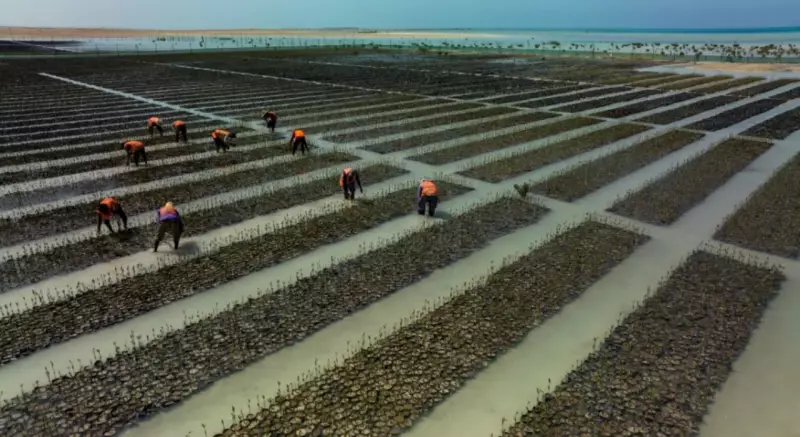
In a nation where over 95% of the land is desert, sand is more than just terrain; it is the bedrock of culture and history. The Bedouin way of life, ancient camel trade routes, and vital oases have forged Saudi Arabia's identity, making the Kingdom and its deserts inseparable. However, scientific history reveals a different past. Long before the discovery of oil and the drawing of modern borders, vast regions of present-day Saudi Arabia were part of "Green Arabia," a lush epoch with higher rainfall and abundant vegetation that supported thriving ecosystems.
The Ambitious Blueprint: From Desert to Green Horizon
This historical contrast is the driving force behind Saudi Arabia's monumental environmental push, which is rooted in pragmatism, not just symbolism. The Kingdom's famed endurance in harsh conditions, later amplified by oil wealth, did little to alter the fundamental nature of the land. Recognizing that long-term stability cannot rely solely on a finite resource, Saudi Arabia is now betting on making its landscape more resilient. The cornerstone of this effort is the Saudi Green Initiative (SGI), launched in 2021 under the patronage of Crown Prince and Prime Minister Mohammed bin Salman.
At its heart lies one of the world's most ambitious environmental pledges: to plant 10 billion trees across the country. This colossal undertaking aims to rehabilitate approximately 74.8 million hectares of land, directly combating desertification and aiming to restore ecological balance. The scale of the challenge is immense. Saudi Arabia is home to the Rub' al Khali, Earth's largest continuous sand desert, spanning over 650,000 square kilometres. With rainfall, arable land, and forest cover all significantly below global averages, large-scale greening is a formidable task.

Despite the harsh environment, progress is underway. By July 2025, the Kingdom had already planted more than 151 million trees and rehabilitated around 500,000 hectares, as reported by Environment, Water and Agriculture Minister Abdulrahman Al-Fadley. This builds on momentum from earlier efforts, where 41 million trees were planted between 2017 and 2023. The targets are clear: over 600 million trees by 2030, leading to the ultimate goal of 10 billion.
Science Before Scale: The Strategy for Survival
Planting trees on this scale in one of the planet's most arid regions is a massive scientific and logistical challenge. Success requires more than just putting saplings in the ground; it demands ensuring their long-term survival. Before announcing the target, authorities conducted a rigorous two-year feasibility study. Led by the Ministry of Environment, Water and Agriculture (MEWA) and the National Center for Vegetation Development and Combating Desertification (NCVC), the study involved over 1,150 field surveys and advanced geospatial analysis.
Scientists meticulously mapped factors like soil composition, water availability, temperature, and wind patterns to identify where vegetation could realistically thrive. A key principle has been prioritizing native species to restore natural ecological balance, avoiding water-intensive foreign plants. The resulting roadmap, unveiled in October 2023, outlines a two-phase approach. The initial phase (2024-2030) focuses on nature-based restoration across cities, highways, rangelands, and protected areas, using sustainable irrigation and water reuse. A subsequent phase will involve more comprehensive, managed interventions.
Beyond Trees: A Holistic Vision for Resilience
While tree planting is the most visible element, the Saudi Green Initiative is a comprehensive, systems-level strategy aligned with Vision 2030. It operates on three core pillars: cutting emissions, expanding vegetation, and protecting land and sea. By the end of this decade, Saudi Arabia aims for concrete outcomes: protecting over 30% of its land and marine territory, reducing carbon emissions by 278 million tonnes annually, and sourcing 50% of its electricity from renewables by 2030. The long-term goal is to achieve net-zero emissions by 2060 through a Circular Carbon Economy model.

Tangible progress is already visible. Protected terrestrial areas have skyrocketed from 4.5% to 18.1% of the Kingdom's territory, and the number of national parks has grown from 18 to 500. Marine protection zones have expanded by 260%, with over 8,000 endangered species reintroduced. A robust monitoring network of 240 air-quality stations supports these efforts.
Addressing the critical water constraint, Saudi Arabia has become the world's largest producer of desalinated water, with daily capacity nearly doubling since 2016 to 16.6 million cubic metres. The country reuses 32% of its water and has increased strategic storage capacity by 600%. Innovative methods like cloud seeding, with 711 flights conducted, and the construction of 1,000 rainwater-harvesting dams further supplement supply. These efforts earned Saudi Arabia recognition from the UN Water Committee as a global model for water sustainability.
The initiative is also framed as social and economic policy. It is expected to generate jobs in nursery management, irrigation, park development, and environmental tech. In cities, increased green cover is projected to lower urban temperatures by at least 2.2°C and improve public health. Major projects like Green Riyadh, aiming to plant 7.5 million trees, and the Green Qibla initiative in Makkah, targeting 15 million trees by 2036, are transforming urban landscapes. Backed by investments exceeding $186 billion across 77 initiatives, the SGI represents a pragmatic attempt to build resilience, reduce environmental risk, and secure a sustainable future beyond oil, without erasing the Kingdom's enduring desert identity.