Scientists Issue Dire Warning on 'Hothouse Earth' Trajectory
For millennia, human civilization has thrived within a relatively stable climate, with predictable seasons and gradual environmental shifts that allowed agriculture and cities to flourish. However, a groundbreaking new study published in One Earth warns that this era of calm is rapidly ending. Researchers, including lead authors climate scientist William J Ripple and Earth system researcher Johan Rockstrom, argue that we are exiting the stable conditions of the Holocene—the past 11,700 years—and entering a perilous phase of self-sustaining warming.
The Risk of Amplifying Feedback Loops
The study highlights the concept of "amplifying feedback loops," where warming triggers processes that further accelerate temperature rises without human intervention. For instance, as Arctic ice melts, it exposes dark ocean water that absorbs more heat instead of reflecting sunlight, leading to more ice melt and increased warming. Other examples include thawing permafrost releasing stored carbon, dying forests losing their ability to absorb carbon dioxide, and changes in cloud cover that allow more solar energy to penetrate. Each loop acts as a mechanism where warming begets more warming, creating a vicious cycle that could become uncontrollable.
Tipping Elements and Cascading Effects
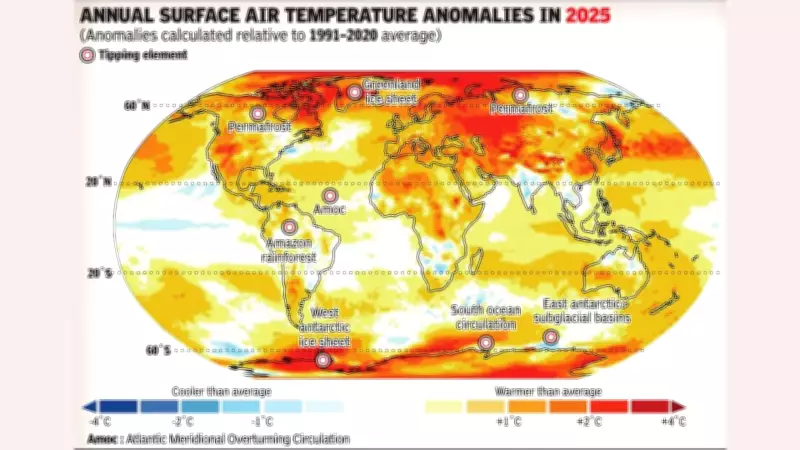
Scattered across the globe are "tipping elements"—large components of the Earth system that can abruptly and permanently shift into new states when pushed past certain temperature thresholds. The study identifies sixteen such elements, including the Greenland Ice Sheet, the Amazon rainforest, and the Atlantic Ocean's overturning current. The real danger lies in their interconnectedness: triggering one tipping element can push others closer to their own thresholds, leading to a cascade of irreversible changes.

For example, rising greenhouse gas emissions warm the Arctic, melting sea ice and the Greenland Ice Sheet. This meltwater disrupts ocean currents, altering rainfall patterns in the tropics and drying out parts of the Amazon. As trees die, they release carbon, further warming the planet and perpetuating the cycle. The authors emphasize that such tipping cascades have the potential to drive self-sustaining climate change, making it critical to address these risks immediately.
Current Climate Realities and Future Projections
The Paris Agreement's target of limiting warming to 1.5°C above pre-industrial levels was crossed for twelve consecutive months in 2024, with climate models suggesting this may reflect a long-term average rather than a temporary spike. The rate of warming has accelerated dramatically, from about 0.05° per decade in the mid-twentieth century to approximately 0.31° per decade now—a sixfold increase. At this pace, the planet could surpass 2°C of warming before mid-century.
Complicating matters, the reduction of industrial air pollution, which has masked some warming by reflecting sunlight, could unveil an additional 0.5°C of warming as cleaner energy sources replace fossil fuels. Current national pledges and policies, assessed by the UN Environment Programme, put the world on track for peak warming of roughly 2.8°C by 2100. In 2024, global energy-related CO2 emissions hit a record 37.8 billion tonnes, with atmospheric CO2 levels at 422.5 parts per million—50% higher than pre-industrial times.
Uncertainty and the Call for Action
The paper acknowledges uncertainty regarding the precise temperature thresholds for tipping elements, with estimates for the Greenland Ice Sheet ranging from 0.8°C to 3.4°C of warming. However, the authors stress that this uncertainty should not lead to delay but rather serve as a compelling reason for immediate precautionary action. They distinguish between a "hothouse trajectory," which can still be interrupted, and a "hothouse state"—a future of extreme heat and significantly higher sea levels that would be irreversible.
Scientists are not predicting a hothouse outcome with certainty but insist that policymakers must take the risk seriously. The study underscores the urgent need for enhanced climate policies to avert catastrophic, self-sustaining warming and protect the planet for future generations.