

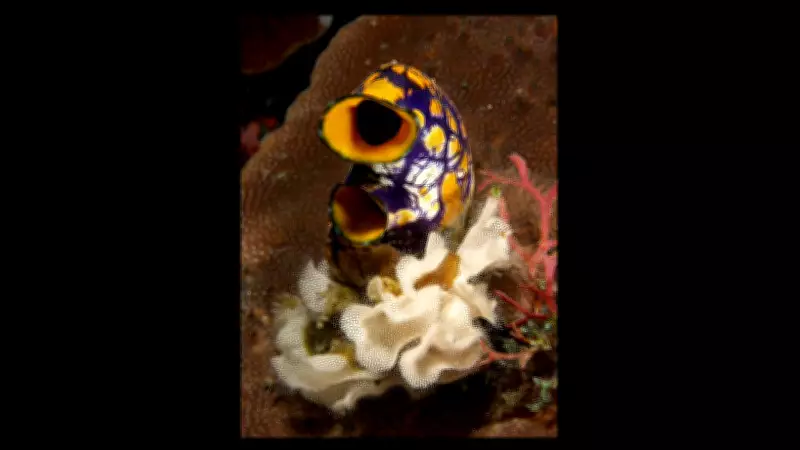
The Bizarre Brain-Eating Survival Strategy of Sea Squirts
In the vast and mysterious depths of the ocean, countless organisms exist that challenge our fundamental expectations of life. Among these, the sea squirt stands out as one of the most peculiar and fascinating creatures. At first glance, an adult sea squirt appears as nothing more than a simple, rock-attached blob, but its early developmental stages reveal a complexity that defies this humble appearance.
What Exactly Is a Sea Squirt?
Sea squirts, scientifically known as ascidians, are marine invertebrates commonly found clinging to various surfaces such as rocks, ship hulls, and coral reefs. As adults, they possess a sac-like, tubular body that filters water to obtain food. However, the larval form of sea squirts is dramatically different and far more active.
The larvae are free-swimming and resemble tadpoles, equipped with a notochord—a primitive structure similar to a backbone—a tail, and even a rudimentary brain. This brain structure aids in navigation and orientation, allowing the larvae to actively seek out suitable surfaces for attachment. According to studies like "Sea Squirt Ciona intestinalis," these larvae demonstrate a remarkable ability to choose and settle on optimal locations.

The Astonishing Metamorphosis: Why Sea Squirts Eat Their Own Brain
Once a sea squirt larva finds and attaches itself to a surface, it undergoes an incredible transformation. This metamorphosis involves the digestion of its tail and, most astonishingly, its brain. While this act might seem extreme or self-destructive, it is a calculated survival strategy driven by necessity.
Scientists explain that after attachment, the sea squirt no longer requires mobility or complex thought processes. Research, such as "The larval ascidian nervous system: the chordate brain from its small beginnings," indicates that the larval nervous system is rapidly degraded during metamorphosis. This degradation allows the organism to conserve energy, as maintaining a brain consumes significant resources.
By digesting its brain, the sea squirt reallocates energy to more critical functions, such as feeding and reproduction. In essence, this sacrifice enhances its survival, showcasing an evolutionary adaptation where efficiency trumps intelligence.
Evolutionary Insights and the Nature of Intelligence
The life cycle of the sea squirt offers profound insights into evolution and how organisms adapt to their environments. It challenges the common notion that evolution always progresses toward greater complexity. Sea squirts belong to the same phylum as vertebrates, making their simple adult form particularly intriguing.
Despite their lack of a brain in adulthood, their larval characteristics align them with more complex species, including humans. This oddity contradicts the belief that high intelligence is universally advantageous for survival. For sea squirts, intelligence is only beneficial temporarily; once they settle, they evolve to thrive without it.
In conclusion, the sea squirt exemplifies that survival in nature is not necessarily about intelligence or complexity but about efficiency. Digesting its own brain is not a handicap but a well-orchestrated evolutionary adaptation, highlighting the diverse and sometimes counterintuitive paths life can take.






