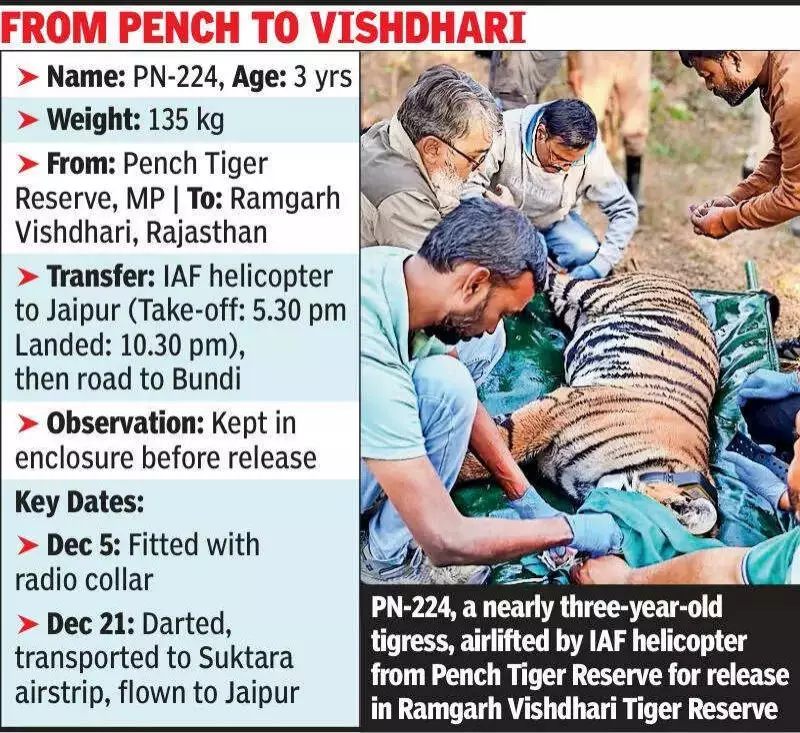
In a landmark move for India's wildlife conservation, a young tigress embarked on a historic journey from Madhya Pradesh to Rajasthan on Sunday evening. This operation marks the country's second successful interstate tiger relocation, a strategic initiative designed to bolster the genetic diversity and long-term viability of Rajasthan's tiger population.
The Journey of Tigress PN-224
As dusk settled over the forests of central India, an Indian Air Force MI-17 helicopter took off from the Pench Tiger Reserve in Madhya Pradesh shortly after 5:30 PM. On board was the precious cargo: a tigress identified as PN-224. Weighing 135 kg and just under three years old, she was carefully selected for this mission to enhance the gene pool of the Ramgarh Vishdhari Tiger Reserve in Bundi, Rajasthan.
The original plan involved a direct helicopter transfer to Bundi. However, due to constraints related to night-landing, the strategy was adapted. The tigress was first flown to Jaipur. A senior forest official confirmed that she landed at Jaipur airport around 10:25 PM. From there, she completed the final leg of her journey to Bundi by road in a secure vehicle.

Months of Meticulous Planning and Tracking
Deputy Director of Pench Tiger Reserve, Rajneesh Kumar Singh, revealed that the relocation operation was the result of over a month of systematic planning and execution. The Pench management team identified a suitable tigress and employed advanced technology to monitor her movements.
Approximately 50 AI-based camera traps and motion-sensor cameras were installed across the area to track PN-224 continuously. Field staff from the Kurai and Rukhad ranges played a crucial role, checking camera traps twice daily, maintaining rigorous patrols, and searching for signs of the tigress from 6 AM to 6 PM every day.
The operation faced a brief setback earlier in December. PN-224 was successfully tranquillised and fitted with a radio collar on December 5 after a week-long search. However, the collar slipped off within 24 hours, likely after getting caught in dense undergrowth, forcing the teams to restart tracking the agile young tigress.
A High-Priority Conservation Mission
This interstate transfer follows high-level directives to expedite such conservation efforts. In August, a meeting at Parliament House, chaired by Lok Sabha Speaker Om Birla and attended by Union Environment Minister Bhupender Yadav and Rajasthan Forest Minister Sanjay Sharma, emphasized the urgency of the project.
Om Birla underscored the importance of the initiative, stating, "Strengthening our tiger population is not just about conservation; it is about safeguarding the legacy of our forests for future generations."
The Rajasthan Forest Department, in a press statement, hailed the transfer as a significant milestone. "The safe transfer of the tigress... was made possible through interstate coordination, the proactive efforts of the Rajasthan Forest Department, and the support of the Indian Air Force," the statement read. It described the move as a decisive step towards developing Ramgarh Vishdhari into a robust tiger landscape.
Following protocol, the tigress will be kept in a dedicated enclosure at her new home for observation before her eventual release into the wild of the Ramgarh Vishdhari Tiger Reserve. This carefully orchestrated move represents a new chapter in collaborative conservation for India's national animal.