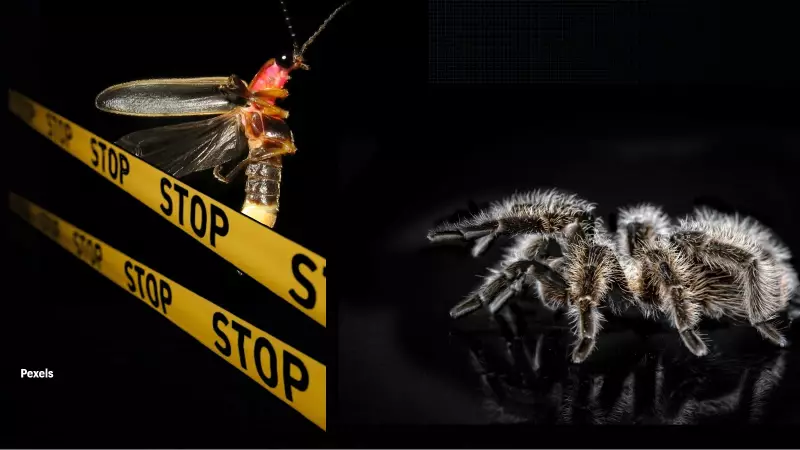
In a fascinating twist of nature's cunning, researchers have discovered that some spiders have developed a form of biological imprisonment, using their prey as glowing lures. A study published in the Journal of Animal Ecology reveals that certain nocturnal spiders in the subtropical forests of East Asia capture fireflies but do not consume them immediately. Instead, they keep these bioluminescent insects alive in their webs, exploiting their natural light to attract an even greater number of victims.
The Glowing Prisoners of the Forest Night
The research focused on spiders that construct flat, sheet-like webs close to the forest floor. Scientists observed that when a firefly became ensnared, the spider exhibited unusual restraint. Unlike with other caught insects like moths, which were promptly eaten, the spiders left the fireflies untouched, allowing them to continue glowing for up to an hour. This period aligns with the typical duration a firefly glows to attract a mate. In this grim scenario, however, the light serves a macabre new purpose: it becomes a beacon that draws in more unsuspecting insects directly to the spider's trap.
LED Experiments Confirm the Deadly Strategy
To test their hypothesis that the spiders were intentionally using the glow as bait, the researchers conducted controlled experiments. They placed small LED lights that mimicked fireflies on some webs, while leaving others dark. The results were striking and conclusive. Webs equipped with the artificial glow attracted nearly three times more insects overall than the non-lit webs. Even more telling was the data on fireflies themselves: illuminated webs captured about ten times more fireflies than their dark counterparts.

This evidence solidly proves that the light plays a critical role in the spider's hunting success. The strategy is a brutal exploitation of the firefly's own communication system. Most of the fireflies caught were males, likely fooled by the steady captive glow into thinking they had found a potential female partner.
A Calculated Change in Predatory Behaviour
The study suggests this is a learned behavioural adaptation. The spiders appear to recognize fireflies by their distinctive light and modify their usual ‘catch-and-eat’ routine accordingly. They patiently wait for the firefly's glow to fade, which signals that its usefulness as bait is over, before finally consuming it. This tactic is different from creatures like the anglerfish, which generates its own light. These spiders have effectively outsourced the luminescence, turning another species' mating signal into a deadly dinner bell.
This discovery adds a complex layer to our understanding of predator-prey dynamics and animal intelligence. It shows that sophisticated, manipulative hunting strategies are not solely the domain of large-brained animals but can evolve in some of nature's smallest architects.