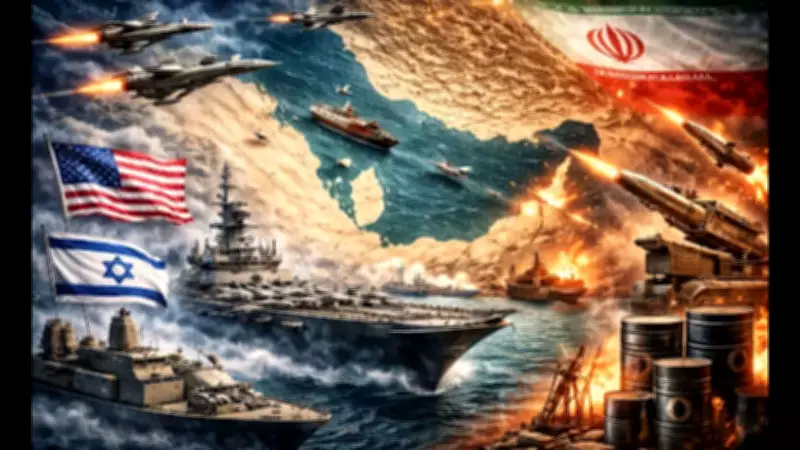
Strait of Hormuz Crisis Intensifies Following US-Israel Military Strikes on Iran
The Strait of Hormuz, a narrow maritime corridor in the Middle East, has returned to global focus amid escalating regional hostilities. Military strikes by the United States and Israel on Iran over the weekend, followed by Iranian retaliation, have sent shockwaves through international markets, raising alarms about potential disruptions to crude oil supplies and prices.
Military Escalation and Immediate Fallout
US President Donald Trump authorized coordinated strikes with Israel against Iran, targeting locations near the offices of Supreme Leader Ayatollah Ali Khamenei. Iranian media reported attacks across multiple regions, while Trump announced in a social media video that the US had initiated "major combat operations in Iran," citing concerns over Iran's nuclear program and missile development.
In response, Iran has threatened retaliatory measures that could include restricting or completely shutting down traffic through the Strait of Hormuz. This strategic waterway, situated between Iran to the north and the United Arab Emirates and Oman to the south, serves as the primary connection between the Persian Gulf and the Indian Ocean.

Strategic Importance of the Strait of Hormuz
The Strait of Hormuz represents one of the world's most critical energy chokepoints. Stretching approximately 100 miles (161 kilometers) in length, it narrows to just 21 miles at its tightest section, with navigation lanes only two miles wide in each direction. Its shallow waters and proximity to Iranian coastlines make vessels vulnerable to naval mines, shore-launched missiles, and patrol craft.
Why does this narrow passage command such global attention? The answer lies in energy economics:
- Approximately one-fourth of global seaborne oil shipments transit through this corridor
- Over 20 million barrels per day of crude oil, condensates, and refined fuels moved through the strait last year
- Most Persian Gulf exporters lack viable alternative sea routes for their shipments
- OPEC members including Saudi Arabia, Iran, UAE, Kuwait, and Iraq depend heavily on this route for Asian market deliveries
- Qatar, a leading global LNG exporter, relies almost entirely on this passage for its shipments
Potential Impact on Global Oil Markets
According to Muyu Xu, senior crude analyst at Kpler Ltd, even a single-day blockade by Iran could propel oil prices to between $120 and $150 per barrel. For context, Brent crude had averaged just $66 per barrel earlier this year. Any significant obstruction of tanker traffic from Middle Eastern producers to key markets like China, Europe, and the United States would disrupt global supplies, elevate crude prices, and potentially destabilize the world economy.
Ali Vaez, director of the Iran Project at the International Crisis Group, warns that escalating conflict could push energy prices higher, undermining political claims about stable fuel costs. "Even limited disruption could spike energy prices, fuel inflation, and rattle global markets," Vaez noted on social media, emphasizing that roughly one-fifth of the world's oil supply passes through this strategic waterway.
Specific Implications for India
India faces particular vulnerability to Strait of Hormuz disruptions:
- The country imports approximately 90% of its crude oil requirements
- Nearly half of India's natural gas consumption depends on overseas suppliers
- Roughly 40% of India's crude purchases originate from Middle Eastern producers like Iraq, Saudi Arabia, UAE, and Kuwait, with most shipments transiting the strait
- With reduced Russian oil imports due to US sanctions, India has limited alternatives if Hormuz supplies are disrupted
A sustained rise in crude oil prices would significantly impact India's economy and energy security.

Feasibility of Strait Closure and Iranian Capabilities
While Iran has repeatedly threatened to close the Strait of Hormuz during previous geopolitical tensions, complete closure remains legally and practically challenging. Under the United Nations Convention on the Law of the Sea, coastal nations maintain sovereignty extending only 12 nautical miles from their shores—less than the strait's narrowest width. The convention also guarantees "innocent passage" through territorial waters and prohibits obstruction of international straits.
However, Iran possesses multiple means to disrupt maritime traffic without formal closure:
- Deployment of small, fast patrol boats to harass commercial shipping
- Missile or drone attacks targeting oil tankers
- Potential naval mine deployment (though this risks Iran's own vessels)
- Electronic interference, including GPS signal disruption, which affected thousands of vessels during previous Iran-Israel conflicts
The United States and allied nations have implemented countermeasures, including increased vessel speeds through the strait and recommendations to maintain distance from Iranian waters. Western naval forces would likely respond to any significant closure attempt.
Economic Consequences for Iran
Closing the Strait of Hormuz would carry substantial economic costs for Iran itself:
- Iran would be unable to export its own oil through the waterway
- Relations with China—Iran's largest crude purchaser and important UN Security Council ally—could deteriorate
- Vessel-tracking data indicates Iran transported more crude through the channel in 2025 than at any time since 2018
Alternative Export Routes
While some regional producers have limited alternatives to the Strait of Hormuz, most remain heavily dependent:
- Saudi Arabia: Can divert up to 5 million barrels daily via its 746-mile East-West Pipeline to a Red Sea terminal
- United Arab Emirates: Has the Habshan-Fujairah pipeline with 1.5 million barrel daily capacity to the Gulf of Oman
- Iraq: Operates a pipeline through Turkey to the Mediterranean, though most exports still depart from Basra via the strait
- Kuwait, Qatar, and Bahrain: Have no practical alternative routes and depend entirely on the waterway
The current escalation underscores the fragile balance in global energy security and the disproportionate impact that regional conflicts can have on worldwide economic stability. As tensions mount, markets remain vigilant for any signs of disruption to this critical maritime artery.