

Farmers in Dryland Telangana Sound Alarm on Climate Change Impacts
A comprehensive study examining farmers' perceptions of climate change vulnerability in the dryland regions of Telangana has uncovered alarming trends, with a significant majority expressing deep concerns about the sustainability of their livelihoods. The research, conducted collaboratively by the International Crops Research Institute for the Semi-Arid Tropics (ICRISAT) and the University of Agricultural Sciences in Raichur, Karnataka, surveyed agricultural communities to gauge their firsthand experiences with shifting environmental conditions.
Widespread Concerns Over Traditional Practices and Water Scarcity
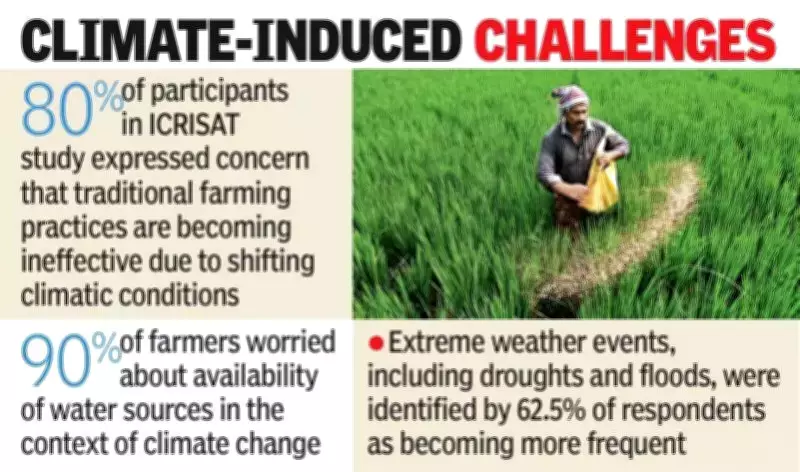
The findings reveal that 80% of participating farmers are concerned that traditional farming methods are becoming increasingly ineffective as climatic patterns evolve. This sentiment is compounded by the fact that 90% of respondents reported heightened anxiety about the availability of water sources, a critical resource in these semi-arid areas. These perceptions align with global scientific assessments, such as those from the Intergovernmental Panel on Climate Change (2021), which identify agriculture as one of the most climate-sensitive sectors worldwide.
Direct Impacts on Agricultural Productivity and Profitability
Approximately 58% of farmers agreed that agriculture is growing more vulnerable due to climate change, with 54.2% specifically noting that uncertainty in rainfall patterns is negatively affecting crop production. Furthermore, 62.5% of respondents identified extreme weather events, including droughts and floods, as becoming more frequent and intense, directly impacting agricultural outputs in these regions.

Nearly 58% of farmers also reported significant changes in cropping seasons and practices, making it difficult to determine optimal times for sowing and harvesting. This disruption has tangible economic consequences, as about 58% stated that climate change directly influences farm profitability, underscoring the economic vulnerabilities arising from climate-induced yield variability.
Increased Incidence of Climate-Related Threats
Respondents documented a rise in specific climate-related hazards, with 54.2% observing an increase in droughts and 56.3% reporting more frequent hailstorms in recent years. These observations support earlier findings by researchers like Rao et al. (2020), who documented heightened climate-induced risks in agricultural systems.
Additionally, 60.5% of farmers noted higher incidences of invasive weed species and pests, linking these proliferations to altered climatic conditions that favor their spread. This adds another layer of challenge to maintaining crop health and productivity.
Socio-Economic Ramifications and Livelihood Vulnerabilities
Perhaps most concerning are the socio-economic implications highlighted in the study. 54.1% of respondents indicated that climate change is forcing farmers to migrate to urban areas, pointing to a growing trend of climate-induced rural-to-urban migration that threatens community stability and cultural continuity.
The vulnerability extends beyond crop farming, with 60.4% reporting that livestock rearing is increasingly at risk and 60.5% observing that overall livelihood patterns are becoming more precarious. These insights reinforce documentation from the Food and Agriculture Organization (2020), which has noted significant disruptions in livestock systems and rural livelihoods globally due to climate-related stresses.
The study underscores the urgent need for adaptive strategies and policy interventions to support Telangana's farming communities as they navigate the complex challenges posed by a changing climate.






