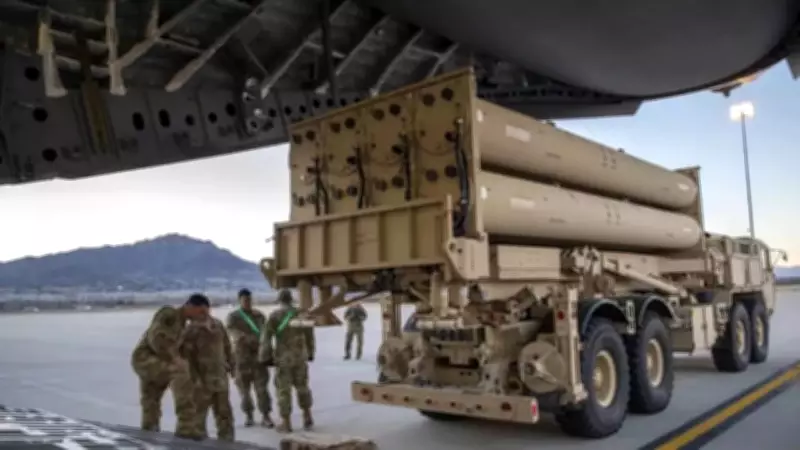
THAAD: The US Missile Defense System with Hit-to-Kill Technology
Iran's Islamic Revolutionary Guard Corps (IRGC) announced on Thursday that it launched the seventeenth wave of attacks under "Operation True Promise-4," targeting strategic sites in Israeli-controlled territories. These attacks successfully bypassed the US-made THAAD missile defense system, one of Washington's most advanced defense technologies, as the ongoing conflict involving Iran, Israel, and the United States intensifies.
Global Defense Systems Under Strain
Despite the death of Supreme Leader Ali Khamenei and several senior officials, Iran has continued to fire projectiles at targets in Israel and across the Middle East. This situation has raised significant concerns for the United States and its allies, including Israel and Gulf countries, which rely heavily on air defense systems to intercept incoming attacks.
Western forces depend on multiple systems to stop missiles and drones. The most critical among them are THAAD interceptors, Patriot missile systems, and the Standard Missile family used by US naval forces. Israel also utilizes its own Arrow interceptor systems. However, these defenses are facing growing pressure as the conflict persists.

Many interceptors have already been supplied to Ukraine during its war with Russia. Others were deployed in the Red Sea to protect shipping from attacks by Iran-aligned Houthi forces. Additional systems have been positioned in the Indo-Pacific to defend South Korea and Taiwan from potential threats from North Korea and China, according to news agency PTI.
What is THAAD?
THAAD, short for Terminal High-Altitude Area Defense, is one of the most powerful missile defense systems operated by the United States. It is specifically designed to intercept short-, medium-, and intermediate-range ballistic missiles during the final phase of their flight.
According to the US Department of Defense, THAAD is a key element of US ballistic missile defense. It employs interceptor missiles that use "hit-to-kill" technology to destroy threat missiles. This system can eliminate incoming missiles at distances of approximately 150 to 200 kilometers.
Unlike traditional missile defenses that explode near their targets, THAAD interceptors rely on kinetic energy. This means they destroy incoming missiles by colliding directly with them in mid-air, ensuring a high level of precision and effectiveness.
Advanced Technology and Deployment
The system depends on sophisticated radar and targeting technology. Its AN/TPY-2 radar can detect and track missile threats at very long distances. In forward-based mode, the radar can monitor targets up to around 3,000 kilometers away. In terminal mode, it focuses on missiles descending toward their intended targets.
As per the US Congressional Research Service, the US military currently operates seven THAAD batteries. Each battery includes six truck-mounted launchers with eight interceptors each, along with radar and command systems that coordinate missile defense operations.
THAAD batteries can also integrate with other missile defense systems, such as Aegis systems on US Navy ships and Patriot missile batteries deployed on land. Together, these create a layered defense designed to intercept missiles at various stages of flight.
The system can be rapidly deployed by large US military transport aircraft like the C-17 and C-5, allowing it to be positioned quickly in areas facing imminent missile threats. This mobility enhances its strategic value in global defense scenarios.