

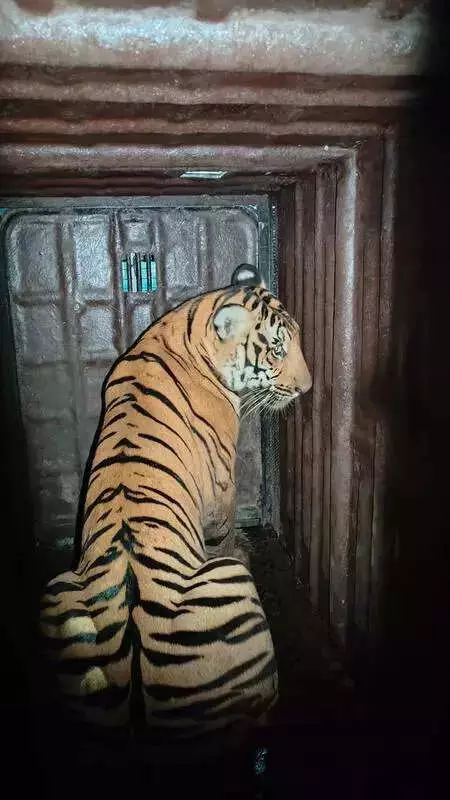
In a carefully coordinated operation, a young tiger that had been preying on cattle was successfully captured in a village bordering the Bandipur forests. The rescue, which took place in the early hours of Thursday, utilized a unique method involving trained elephants to safely secure the animal.
Operation in Bommalapura Village
The incident unfolded in Bommalapura village in Gundlupet taluk of Chamarajanagar district. Forest department authorities had been monitoring a specific tiger, identified as Bandipur 26-GP5, for several days. The four-year-old big cat was reportedly responsible for a series of attacks on cows in and around the village, prompting officials to plan its capture.
Tracking and Capture with Elephant Assistance
Officials employed modern technology alongside traditional methods to track and capture the tiger. Camera traps and drones were used to monitor the animal's movements and pinpoint its location. The actual capture, however, relied on the expertise of three tamed elephants named Prashanth, Kanjan, and Masti.

These elephants played a crucial role in the early morning operation on Thursday, allowing the forest team to safely approach and tranquilize the tiger. The use of elephants is a proven technique in such scenarios, as they can navigate dense terrain and provide a stable, elevated platform for officials.
Post-Capture Health and Next Steps
Following the successful rescue, forest department officials confirmed that the captured tiger is in good health. The animal is now under the care of the authorities. Standard procedure in such cases involves a thorough veterinary examination to assess its condition before a decision is made regarding its future, which could potentially involve relocation to a more suitable habitat away from human settlements.
This operation highlights the ongoing challenges of human-wildlife conflict in regions bordering national parks and the multi-faceted approach—combining technology, traditional knowledge, and skilled personnel—required to manage such situations effectively.






