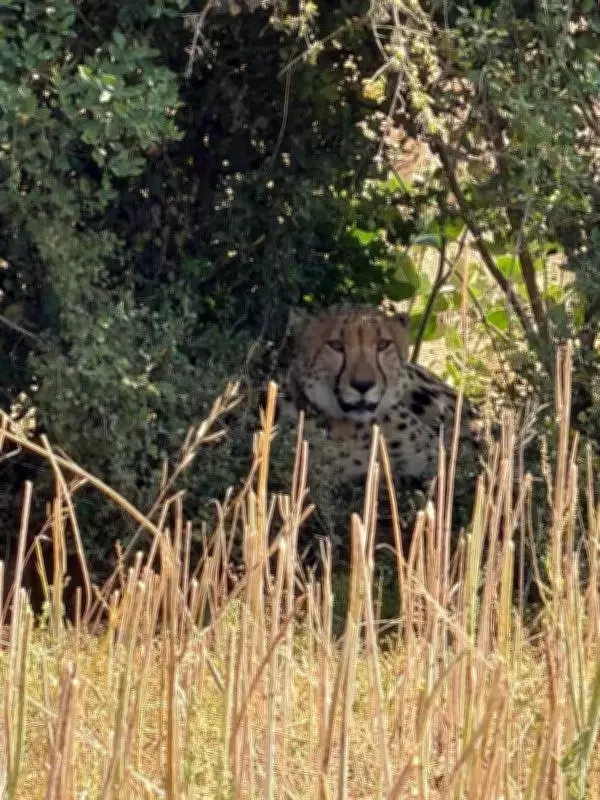
Two Cheetahs from Kuno National Park Now Ranging in Rajasthan's Baran District
Forest officials in Jaipur confirmed on Thursday that two cheetahs from Kuno National Park in Madhya Pradesh are currently ranging in Rajasthan's Baran district. This marks a significant development in the dispersal of these reintroduced big cats into new territories.
GPS Tracking Reveals Movement Patterns
The male cheetah identified as KP-3 recently entered the Ramgarh region of Baran district and was moving approximately 3 kilometers from the Ramgarh Crater. Officials are closely monitoring its location through the GPS collar fitted on the animal, providing real-time data on its movements.
"Earlier, cheetah KP-2 dispersed into the same landscape and has been ranging in the Ramgarh area," a forest official stated. "With the arrival of KP-3, two cheetahs from Kuno are now present in the region."

Coordinated Monitoring Efforts Underway
Teams from the forest departments of both Madhya Pradesh and Rajasthan are actively tracking the movement of both cheetahs through advanced satellite tracking technology. Field staff remain deployed on the ground to ensure continuous surveillance and safety measures.
Villagers in nearby settlements have been advised to avoid unnecessary movement in forest areas to minimize potential human-wildlife conflicts. "This is the fifth instance of a cheetah dispersing from Kuno and reaching Baran district," added the official, highlighting the recurring pattern of movement between the two states.
Pending Memorandum of Understanding for Cheetah Conservation
While the Rajasthan region appears to be favorable habitat for these wild cats, a proposed memorandum of understanding between Rajasthan and Madhya Pradesh for conducting a feasibility study on cheetah movement remains unsigned. This MoU would facilitate research on free movement between Kuno National Park and the larger Kuno-Gandhi Sagar Cheetah Landscape.
"We obtained approval for the MoU from our government. Madhya Pradesh also secured approval and shared the draft with us," revealed a senior official source. "Had it been signed, studies could have commenced, the Wildlife Institute of India could have been involved, and groundwork for developing cheetah grasslands and a coordinated strategy could have begun."
Expansive Conservation Landscape
The larger Kuno-Gandhi Sagar landscape spans nearly 17,000 square kilometers, with 10,500 square kilometers in Madhya Pradesh and 6,500 square kilometers in Rajasthan. This extensive area represents a crucial habitat for cheetah conservation and ecosystem restoration efforts.
The draft MoU outlines several important objectives:
- Using the cheetah as a flagship species for restoring open forests and savanna ecosystems
- Enhancing biodiversity and strengthening ecological balance
- Permitting capture, recapture, or release of cheetahs in emergency situations
- Ensuring all actions comply with the Wildlife (Protection) Act, 1972
- Following protocols established by the Union Ministry of Environment, Forest and Climate Change and the National Tiger Conservation Authority
The continued movement of cheetahs between states underscores the importance of interstate cooperation in wildlife conservation and the need for formal agreements to manage these transboundary populations effectively.