

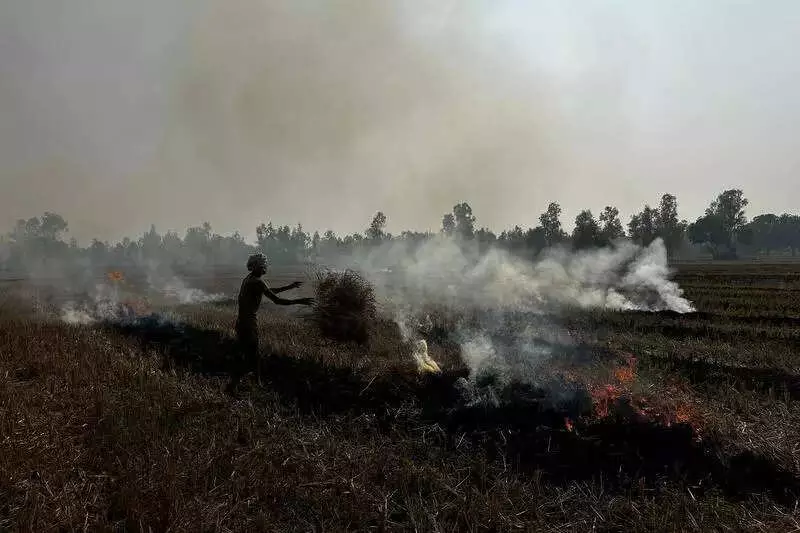
Despite stringent government monitoring, Uttar Pradesh has witnessed a sharp and worrying increase in farm fires this year, posing a significant threat to the region's winter air quality, particularly in the National Capital Region (NCR).
Alarming Data Points to a Growing Crisis
According to the latest satellite data, the state recorded 7,290 incidents of crop residue burning between September 15 and November 30, 2025. This marks a significant jump of 18.6% compared to the 6,142 incidents documented during the same period in 2024. The data comes from the Consortium for Research on Agroecosystem Monitoring and Modelling from Space (CREAMS), a research body under the Indian Agricultural Research Institute (IARI).
This year's figures reveal a disturbing long-term trend. Since 2020, when the state recorded 4,631 cases, stubble burning incidents in UP have surged by a staggering 58%. After a dip to 3,017 cases in 2022, the numbers have been climbing steadily.

Geographical Shifts and National Context
The epicenter of the problem is shifting. While western UP districts like Meerut and Muzaffarnagar have traditionally been hotspots, eastern UP and Bundelkhand are now witnessing a surge. Maharajganj in east UP recorded the highest number at 797 cases, followed by Jhansi (577), Kheri (216), Fatehpur (201), and Kushinagar (200).
On the national stage, Uttar Pradesh accounted for 22% of India's total 33,028 burning incidents during the reviewed period. Madhya Pradesh led the country with 17,067 incidents (over 51%), while Punjab recorded 5,114 and Haryana 662.
Government Response and Root Challenges
The UP government has deployed a multi-pronged strategy combining enforcement, incentives, and promotion of alternatives. Measures include imposing environmental compensation fines based on land area, appointing nodal officers, and providing subsidies for crop residue management machinery. Initiatives like 'Parali Ke Badle Govansh Khaad', which exchanges stubble for cow manure, and the promotion of bio-decomposers are also underway.
Principal Secretary of Agriculture, Ravindra, stated that the department is closely monitoring the situation. He emphasized a focused approach in eastern UP and plans to create more industrial uses for stubble.
However, experts point to deep-rooted challenges: a potential shift in cropping patterns, lack of mechanization in poorer districts, limited government outreach, and the economic burden on small landholders. The critical 15-20 day window between paddy harvest and wheat sowing, coupled with the fact that paddy straw is not widely used as fodder in UP, leaves farmers with few options but to burn for quick field clearance.
This persistent rise in farm fires sets the stage for a difficult winter, with increased episodes of smog and deteriorating air quality across the Indo-Gangetic plains, underscoring the urgent need for more effective and scalable solutions.






