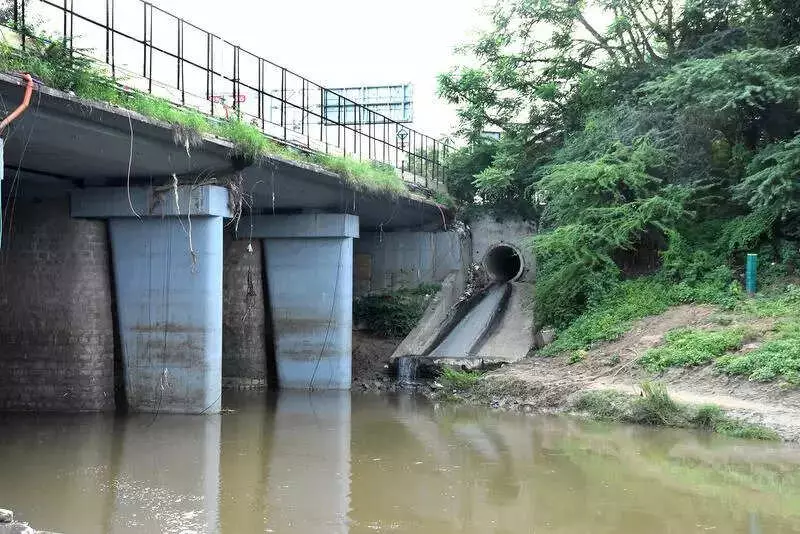
Despite significant strides in the restoration of Vadodara's Vishwamitri river, a persistent challenge remains: the daily inflow of millions of litres of untreated wastewater. The Vadodara Municipal Corporation (VMC) has reported that while the situation has improved, an estimated 16 million litres per day (MLD) of sewage continues to enter the waterway.
Long-Standing Challenge and Recent Momentum
The discharge of wastewater into the Vishwamitri has plagued the city for years. Concerted efforts to address this environmental issue gained substantial traction following persistent advocacy by environmental activists and strict directives from the National Green Tribunal (NGT). The project received an unexpected boost from last year's floods, which compelled the civic authorities to broaden their focus from mere flood control to actively tackling river contamination.
Major Investments and Infrastructure Projects
In the initial phase of this ambitious cleanup, the VMC invested approximately Rs 195 crore to manage nearly 90 MLD of sewage. This phase saw the commissioning of two crucial sewage treatment plants (STPs). The 85 MLD-capacity Atladara STP now intercepts about 60 MLD of sewage before it can reach the river. Simultaneously, the 13 MLD plant at Vemali has successfully reduced discharge by 2 MLD.

Further, the corporation executed sewage line and pumping projects in areas including Gajrawadi, Nagarwada, and Manjalpur. These projects are designed to channel wastewater away from the river and towards existing treatment facilities.
Current Status and Future Pipeline
VMC Standing Committee Chairman, Sheetal Mistry, provided an update on the progress. "From 23 identified spots where wastewater was being released into the river, we have managed to reduce it to about 12 spots. These remaining points release around 16 MLD of sewage-contaminated water. Works in the pipeline will ensure that even this is taken care of," Mistry stated.
Currently, the VMC is rolling out four new sewage pipeline projects, along with associated infrastructure, at a cost of Rs 39.3 crore. These are aimed at further diverting wastewater. Looking ahead, a major reduction is anticipated from the planned installation of micro-STPs along the river's course and the laying of additional pipelines in adjoining localities. These future initiatives are projected to cost around Rs 134 crore.
Expert Opinion and Measurable Improvement
An environmental expert closely monitoring the project offered a technical perspective. The expert advocated for treating sewage at the very points where it enters the river, as opposed to transporting it over long distances through pipelines. "Novel and eco-friendly technologies are available for such decentralized treatment," the expert suggested.
The tangible results of these efforts are now becoming evident in the river's health metrics. Chairman Mistry highlighted a remarkable improvement in water quality. The Biological Oxygen Demand (BOD), a key indicator of organic pollution, averaged around 30 mg/litre between 2016 and 2018. It fluctuated between 20 and 30 mg/litre in the subsequent five years until 2023. However, tests conducted in November of this year revealed a BOD level of just 8 mg/litre, signaling a substantial enhancement directly attributable to the ongoing restoration measures.
While the journey to a completely clean Vishwamitri is ongoing, the data indicates that Vadodara's sustained investment and multi-pronged strategy are steering the river towards a healthier future.