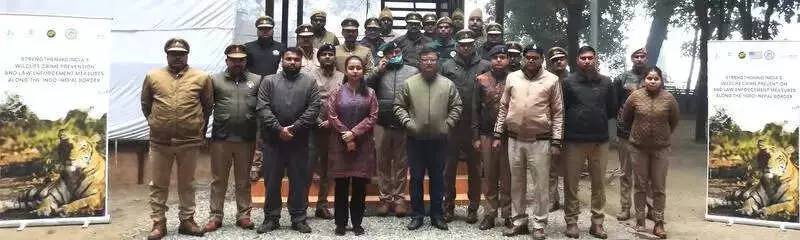
In a significant move to fortify defenses against illegal wildlife trade, the Wildlife Trust of India (WTI) has successfully concluded a specialized two-day training program for frontline forest staff in the sensitive Pilibhit Tiger Reserve (PTR). The session, which ended on Wednesday evening, is a crucial part of WTI's ongoing project titled 'Strengthening India's Wildlife Crime Prevention and Law Enforcement Measures along the India-Nepal Border.'
Boosting Frontline Capacity in a Critical Landscape
The training was strategically held at the Mahof forest range within PTR, a region identified as highly vulnerable due to its proximity to the international border with Nepal. The program brought together 25 forest officials, including rangers, deputy rangers, forest inspectors, and forest guards from both the tiger reserve and the broader forest and wildlife division.
Its core objective was to enhance the investigative, legal, and procedural skills of these personnel. The curriculum was meticulously designed to strengthen their ability to detect offences, mount effective field responses, and, most importantly, prepare legally sound cases capable of withstanding rigorous judicial scrutiny.

From Crime Scene to Courtroom: A Practical Curriculum
The training provided a comprehensive walkthrough of a wildlife crime case, covering every stage from initial detection and field response to investigation, documentation, and final prosecution. A major emphasis was placed on effective wildlife crime scene management, underlining the critical need to secure the scene and systematically document all physical and circumstantial evidence.
A substantial portion of the workshop was dedicated to building an in-depth understanding of the Wildlife Protection Act of 1972. Facilitators led detailed discussions on key definitions and relevant legal provisions applicable to diverse wildlife crime scenarios. The sessions tackled common challenges field staff face, such as correctly applying legal sections and translating on-ground findings into robust, legally tenable offence reports.
To bridge the gap between theory and practice, the training incorporated detailed analyses of real-life case studies from past wildlife crime investigations. These discussions allowed participants to examine investigative lapses, identify best practices, and understand how meticulous documentation and correct legal framing can dramatically improve conviction rates.
Integrating International Law and Equipping Field Staff
Recognizing the transboundary nature of crime in the region, the training also highlighted the importance of the Convention on International Trade in Endangered Species (CITES). Officials were familiarized with CITES's relevance in cases involving international trade, the process of applying its provisions, and the correct method of incorporating these international legal elements into domestic case files.
The integration of national and international legal frameworks was presented as a powerful tool to strengthen cases during trial and create an effective deterrent. To directly enhance on-ground capabilities, eight basic wildlife crime investigation kits were distributed to participants to improve their immediate response and evidence-handling skills during incidents.
Furthermore, eight copies of a practical "Wildlife Identification and Post-Seizure Guide" booklet were provided. This resource is designed to assist frontline staff in accurately identifying species and properly handling seized wildlife and their derivatives, a common point of procedural weakness.
The training was led by Jose Louies, CEO of WTI, and Pradipty Bharadwaj, a legal and cyber intelligence analyst at Langland Conservation. To ensure the program's effectiveness and measure knowledge gain, pre- and post-training assessments were conducted, confirming tangible learning outcomes for all participants.