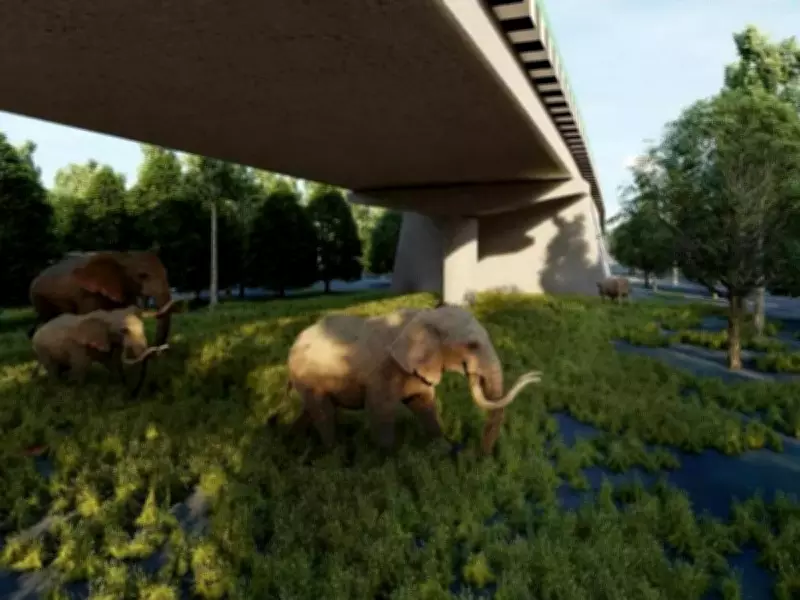
Wildlife Underpasses Prove Highly Effective on Delhi-Dehradun Economic Corridor
A comprehensive 40-day observational study conducted along a critical section of the Delhi–Dehradun economic corridor has yielded promising results for wildlife conservation. The research, focused on the corridor's passage through Uttarakhand's ecologically sensitive Shivalik forest, demonstrates that specially designed underpasses are being actively utilized by numerous animal species, facilitating their natural movement around the major road infrastructure project.
Methodology and Camera Trap Deployment
The recently published study, conducted by Dehradun's prestigious Wildlife Institute of India, employed systematic monitoring techniques across a 3.5-kilometer stretch from Mohand village to Ganeshpur in Uttarakhand. Researchers strategically deployed 150 camera trap units along the underpasses, ensuring comprehensive detection capabilities for terrestrial fauna ranging from small to large-bodied species.
Each camera trap was meticulously positioned to capture wildlife activity patterns, creating a detailed observational network that recorded animal movements with precision throughout the study period.

Significant Findings and Species Documentation
Initial analysis of the collected data revealed remarkable results: 40,444 camera trap images documented 18 distinct wild species utilizing the viaduct structures with varying frequencies. The most frequent users identified in the study include:
- Nilgais (blue bulls)
- Sambar deer
- Chital (spotted deer)
- Hares
- Golden jackals
- Elephants
The spatial and temporal patterns observed indicate that wildlife generally avoids areas with human presence and activity, demonstrating natural behavioral adaptations to the infrastructure.
Expert Analysis and Future Implications
Bilal Habib, the study's principal investigator and a professor at the Wildlife Institute of India, emphasized the importance of continued monitoring. "Continued long-term monitoring, including acoustic and behavioral assessments, will further strengthen our understanding of how such large-scale interventions can reduce barrier effects and guide future infrastructure design across India's biodiversity-rich landscapes," Habib stated.
The findings carry substantial significance as India continues developing highway projects through forested regions. Proper interventions are essential for ensuring safe wildlife passage while minimizing disturbance to natural habitats.
Proactive Conservation Measures
Recognizing the ecological importance of the area, the National Highway Authority of India proactively approached the Wildlife Institute of India to conduct a rapid assessment of wildlife interactions with the road infrastructure. The collaboration aimed to identify mitigation measures that would minimize negative impacts on local fauna.
Based on the institute's recommendations, approximately 11 kilometers of underpass structures were developed specifically to facilitate wildlife movement. These purpose-built passages represent a forward-thinking approach to infrastructure development that balances economic progress with environmental conservation.
The successful implementation and documented usage of these underpasses provide a valuable model for future infrastructure projects in ecologically sensitive areas across India and potentially in other biodiversity-rich regions globally.