

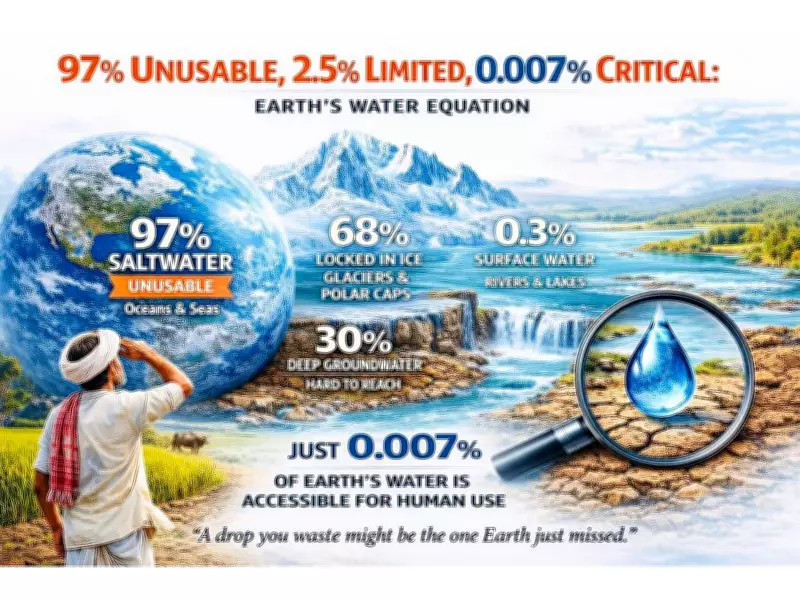
World Water Day Exposes Earth's Fragile Water Equation: 97% Unusable, 0.007% Critical
As the world observes World Water Day, the stark reality of Earth's water resources comes into sharp focus. Often dubbed the "blue planet" due to its 70% water-covered surface, Earth presents an illusion of abundance that masks a critical scarcity threatening global sustainability.
The Alarming Breakdown of Global Water Resources
Pavan Kaushik, Co-founder of Gurukshetra Consultancy, author, and storyteller, emphasizes the dire statistics. Approximately 97% of Earth's water is saline, found in oceans and seas, rendering it unfit for direct human consumption. Of the remaining 2.5% that is freshwater, the majority is inaccessible: 68-69% is trapped in glaciers and polar ice caps, while another 30% exists as deep groundwater, making extraction costly and technically challenging.
The Minuscule Lifeline: Surface Water at 0.007%
What remains for human use is a tiny fraction: surface water from rivers, lakes, and wetlands constitutes just 0.3% of freshwater, translating to a mere 0.007% of total global water. This minuscule portion sustains billions of people, supports agriculture, powers industries, and maintains ecosystems, serving as the lifeline of civilization.

Roots of the Crisis: Accessibility, Not Availability
Kaushik points out that the crisis stems not from a lack of water but from severe limitations in accessibility. With rising global populations, rapid urbanization, and unpredictable climate patterns, pressure on this critical 0.007% intensifies. Rivers are shrinking, groundwater tables are declining, and pollution further degrades already limited resources.
Misconceptions and Complacency in Water Usage
A widespread misconception that water is abundant due to its visibility has led to complacency in conservation and inefficient usage across sectors. In reality, water is a strategic asset influencing:
- Food security
- Public health
- Economic growth
- Geopolitical stability
Call to Action: Individual and Collective Responsibility
Addressing this challenge requires a dual shift in policy, technology, and individual behavior. Conservation begins at the personal level, with every drop saved contributing to a larger impact. Kaushik urges, "Drink as much water as you need—water sustains life. But every drop wasted is a loss we can no longer afford."
Simple actions can drive meaningful change:
- Fixing leaks promptly
- Reducing unnecessary water usage
- Reusing water where possible
- Being mindful in daily consumption
The responsibility for water conservation does not rest solely with governments or institutions; it is equally shared by every individual.
The Profound Equation: Unusable, Limited, and Critical Water
The equation is simple yet profound: the majority of Earth's water is unusable, a small portion is limited, and an almost negligible fraction is critical for survival. Recognizing this imbalance is the first step toward meaningful action. As Kaushik concludes, "Water is not scarce because it is absent—it is scarce because it is accessible only in the smallest measure where it matters most."






