

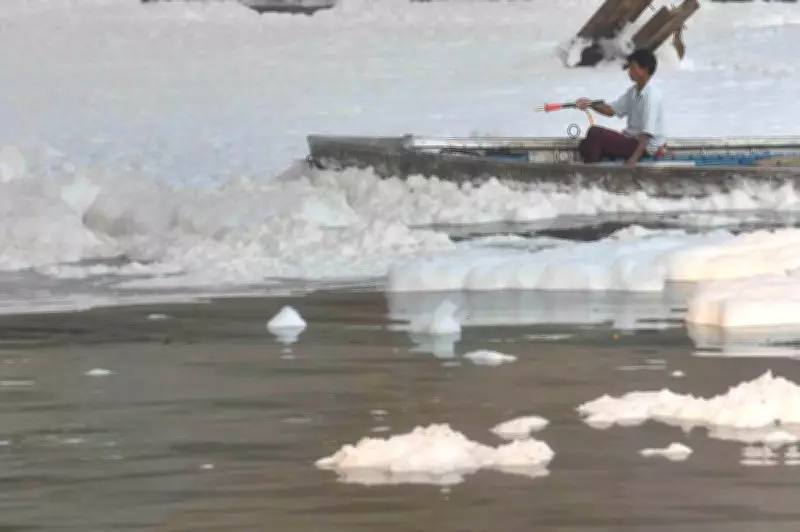
Delhi's Yamuna Pollution Concentrated in Critical 26-Km Stretch
The latest Economic Survey of Delhi for 2025-26 has unveiled a startling environmental reality: a mere 26-kilometer segment of the Yamuna River, flowing through the national capital, is shouldering the overwhelming burden of pollution. This short urban stretch, accounting for less than 2% of the river's total length within Delhi, is identified as the epicenter of the contamination crisis, casting serious doubts on the efficacy of current cleanup efforts.
Pollution Hotspot: Wazirabad to Asgarpur
According to the survey, while the Yamuna traverses approximately 48 kilometers through Delhi, the most severely polluted section lies between Wazirabad and Asgarpur. This downstream area, located beyond major barrages, is inundated with untreated and partially treated sewage, alongside industrial effluents. The primary culprits are 22 drains that discharge directly into the river, including significant carriers like the Najafgarh drain, which also transports wastewater from Haryana, and the Shahdara drain, bringing discharge from Uttar Pradesh. Together, these drains create a relentless influx of pollutants, severely degrading water quality.
Structural Challenges: Inadequate Freshwater Flow
The survey underscores a deeper structural issue beyond mere infrastructure deficiencies: the lack of sufficient freshwater flow. During lean seasons, Haryana releases only 10 cubic meters per second (cumecs) from Hathnikund, but much of this water is lost to evaporation and percolation before reaching Wazirabad. Consequently, the river lacks the necessary flow to dilute pollutants, failing to meet prescribed water quality standards, such as maintaining biochemical oxygen demand (BOD) below 3 mg/l and dissolved oxygen (DO) above 5 mg/l.

Alarming Water Quality Data
Regular monitoring by the Delhi Pollution Control Committee (DPCC) at eight locations from Palla to Asgarpur paints a grim picture. While the upstream stretch at Palla records a relatively healthy average DO level of 7.4 mg/l, conditions deteriorate drastically downstream. At Asgarpur, the influx from major drains causes DO levels to plummet to as low as 1.6 mg/l, highlighting the severe pollution intensity. Additionally, monitoring of 27 drains reveals that most fail to meet BOD standards and other parameters, indicating that wastewater is already beyond acceptable limits before even entering the river.
Gaps in Sewage Treatment Infrastructure
Despite expansions in sewage treatment capacity, which now align with estimated sewage generation, significant gaps persist in actual treatment. The survey notes a treatment gap exceeding 10%, meaning a substantial volume of sewage continues to flow into the Yamuna untreated. This discrepancy underscores the reality behind cleanup claims, as highlighted by reports such as one from The Tribune on the Delhi Gate drain, which discharges untreated wastewater directly into the river.
Implications and Path Forward
The findings reveal a clear pattern: Delhi's Yamuna pollution is not uniformly distributed but intensely concentrated in this short urban stretch. This concentration makes the crisis both more alarming and potentially more manageable. However, without ensuring adequate river flow and enforcing strict controls over drain discharges, improvements in infrastructure alone may prove insufficient to restore the river's health. The data calls for urgent, targeted interventions to address this environmental emergency.






